Sentence Counter for Email Marketing: Write Clearer Emails That Convert
Email marketing remains one of the highest-ROI channels for lead generation and customer acquisition. Despite constant changes in platforms, algorithms, and inbox filters, one factor has never changed: clarity wins. Emails that are easy to read, quick to understand, and focused on one clear action consistently outperform long, cluttered messages.
This is where a sentence counter becomes an unexpectedly powerful tool for email marketers.
At first glance, a sentence counter may seem like a simple writing utility. In reality, it plays a critical role in email readability, engagement, compliance, and conversion optimization—especially when paired with lead generation tools like LeadGen App.
In this article, we’ll explore how a sentence counter directly impacts email marketing performance, why sentence length matters more than most marketers realize, and how to use it strategically to improve open rates, click-through rates, and lead quality.
Why Sentence Length Matters in Email Marketing
Email is not long-form content. Subscribers scan emails quickly—often on mobile devices, between meetings, or while multitasking. Research and real-world campaign data consistently show that short, structured emails outperform verbose ones.
Long sentences introduce friction. They:
- Increase cognitive load
- Reduce clarity
- Lower mobile readability
- Cause readers to abandon emails before reaching the CTA
In contrast, shorter sentences:
- Improve skimmability
- Deliver messages faster
- Keep readers focused on the action
- Align with modern attention spans
A sentence counter helps marketers quantify and control sentence length, instead of relying on subjective judgment.
What Is a Sentence Counter?
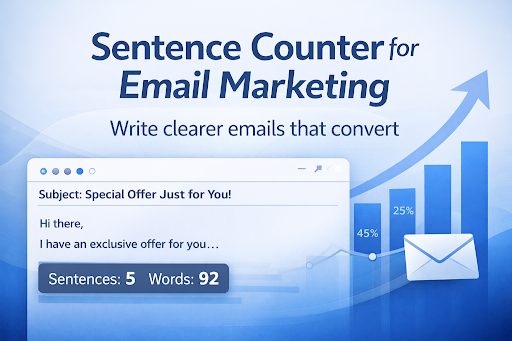
A sentence counter is a writing tool that identifies and counts the number of sentences in a piece of text. While it may appear simple, its value for email marketers is often underestimated. Email performance depends heavily on structure, not just messaging.
Unlike blog posts or whitepapers, emails are consumed quickly. Readers do not carefully analyze each sentence; they skim for relevance and value. A sentence counter helps marketers maintain short, focused sentences that support this reading behavior.
For email marketers, a sentence counter is useful for controlling pacing, avoiding overly complex sentence structures, and ensuring consistent readability across campaigns. It is especially valuable when writing emails designed to drive leads into a conversion funnel built with LeadGen App.
Instead of guessing whether an email feels too long or dense, marketers can rely on sentence data to refine clarity and flow. This turns email writing from a subjective exercise into a more controlled, repeatable process.
The Connection Between Sentence Count and Conversions
Email marketing success is measured by actions: opens, clicks, replies, and form submissions. Every extra sentence adds friction if it does not move the reader closer to the CTA.
Here’s how sentence count directly affects conversion metrics:
1. Open Rates
While subject lines play the biggest role, preview text and first-line clarity strongly influence opens. Short, punchy sentences improve preview readability—especially on mobile inboxes.
2. Click-Through Rates (CTR)
Emails with fewer, clearer sentences guide readers faster to the CTA. A sentence counter helps eliminate unnecessary explanations that dilute urgency.
3. Lead Quality
Clear messaging attracts the right leads. Overly complex emails often confuse prospects and attract low-intent clicks.
4. Response Rates
For outbound and B2B email marketing, shorter sentences feel more human and conversational, increasing reply rates.
Sentence Counter vs. Word Counter: Why Sentences Matter More
Many marketers rely on word count as a measure of email length. While word count has some value, it does not reflect readability. Two emails with the same word count can feel completely different depending on sentence structure.
Word counters measure quantity. Sentence counters measure clarity. In email marketing, clarity is more important than brevity. A short email with long sentences can feel heavier than a slightly longer email with clear, short sentences.
Sentence counters focus on how information is distributed. They help marketers ensure that ideas are broken down into digestible pieces rather than packed into complex statements. This is particularly important for lead generation emails, where understanding drives action.
By prioritizing sentence count over word count, marketers can create emails that feel lighter, more conversational, and easier to engage with—qualities that directly support higher response and conversion rates.
Using a Sentence Counter Across Different Email Marketing Campaigns
Different email campaigns require different levels of detail, but all benefit from controlled sentence structure. Sentence counters help adapt messaging without sacrificing clarity.
Welcome emails should be friendly and simple. Sentence counters ensure these emails do not overwhelm new subscribers with too much information.
Lead nurturing emails often fail because they try to educate too much at once. A sentence counter helps keep each email focused on one idea, making the sequence easier to follow.
Cold outreach emails rely on brevity and relevance. Short sentences feel more personal and less automated, improving reply rates.
Promotional emails benefit from clear separation between value statements and CTAs. Sentence counters help isolate key messages so offers stand out.
Re-engagement emails should be minimal and respectful. Fewer, clearer sentences reduce friction and increase the chance of reactivating dormant leads.
Across all campaign types, sentence counters provide consistency. This consistency strengthens brand voice and improves overall email performance.
Sentence Counters and Mobile Email Optimization
Mobile devices account for the majority of email opens. On small screens, sentence length becomes even more important. Long sentences wrap awkwardly, creating dense blocks of text that are difficult to scan.
Sentence counters help marketers design emails specifically for mobile readability. Shorter sentences naturally create more white space, improving visual hierarchy and flow. This makes emails easier to consume with minimal effort.
Mobile readers are often distracted. They read emails between tasks, during commutes, or while multitasking. Clear, concise sentences allow them to understand the message quickly without re-reading.
For LeadGen App users driving mobile traffic to lead capture forms, this clarity is critical. If the email message is confusing or heavy, users are less likely to complete the form. Sentence counters help ensure mobile emails remain lightweight, readable, and conversion-friendly.
Compliance, Clarity, and Trust
High email engagement does not always equal high-quality leads. Often, unclear messaging attracts clicks from users who are not a good fit. Clear sentence structure helps filter interest more effectively.
When emails use short, direct sentences, expectations are set accurately. Prospects understand what the offer is, who it is for, and what will happen next. This transparency improves lead quality.
Sentence counters help eliminate vague or ambiguous language that can confuse readers. Clear messaging reduces mismatched expectations and increases the likelihood that leads who convert are genuinely interested.
For businesses using LeadGen App, better lead quality means higher form completion rates and more meaningful conversions. Sentence clarity ensures that leads entering the funnel are aligned with the offer, improving downstream performance and ROI.
Using Sentence Counters in a LeadGen App Workflow
Here’s how sentence counters fit naturally into a LeadGen App-powered marketing stack:
Sentence counters integrate naturally into a LeadGen App–driven marketing workflow. They act as a refinement tool between drafting copy and launching campaigns.
A practical workflow starts with drafting the email freely. The copy is then reviewed using a sentence counter to identify long or complex sentences. These sentences are refined for clarity and alignment with the funnel stage.
Next, the email copy is checked against the associated LeadGen App form. The messaging should clearly prepare users for what they will see on the landing page. Sentence counters help ensure this alignment.
By using sentence counters consistently, teams can standardize email quality across campaigns. This is especially valuable for growing teams that hire a virtual assistant to manage email outreach, lead follow-ups, and campaign execution while maintaining a consistent brand voice.
Common Email Writing Mistakes a Sentence Counter Helps Avoid
Many email copy issues stem from poor sentence structure. Sentence counters help prevent several common mistakes.
One frequent issue is overloading sentences with multiple ideas. This makes emails harder to understand and reduces engagement. Sentence counters highlight where ideas should be separated.
Another problem is burying CTAs inside long paragraphs. Shorter sentences naturally create space around CTAs, making them more visible.
Marketers also tend to write emails the way they speak internally, using industry jargon and complex phrasing. Sentence counters encourage simpler, more user-friendly language.
Finally, automated or AI-generated emails often contain long, polished sentences that feel impersonal. Sentence counters help humanize these messages by encouraging a more conversational structure.
Sentence Counters and AI Email Writing Tools
AI tools are increasingly used to generate email copy. Many marketers now pair written emails with short videos created using an AI video generator to boost engagement, making sentence clarity even more important when scripts and captions are repurposed across channels.While efficient, AI often produces long sentences with formal structure. This can reduce authenticity and engagement.
Sentence counters serve as a quality control layer for AI-generated content. They help marketers identify where sentences can be shortened or simplified to sound more human.
By refining AI output with a sentence counter, marketers can maintain speed without sacrificing clarity. This is especially useful for scaling email campaigns while preserving brand voice.
For LeadGen App users, combining AI writing with sentence-level optimization ensures emails remain effective at driving real leads—not just clicks.
Best Practices: Ideal Sentence Count for Email Marketing
While there is no universal rule, data-driven benchmarks suggest:
- Cold emails: 6–10 sentences
- Welcome emails: 8–12 sentences
- Nurture emails: 10–14 sentences
- Promotional emails: 8–15 sentences
- Re-engagement emails: 5–9 sentences
Cold emails typically perform best with 6–10 sentences. Welcome emails usually fall between 8–12 sentences. Nurture emails may range from 10–14 sentences, depending on complexity. Promotional emails often perform well with 8–15 sentences, while re-engagement emails should stay closer to 5–9 sentences.
Sentence counters make it easy to stay within these ranges without guesswork. More importantly, they help marketers evaluate whether each sentence contributes value.
These benchmarks provide structure, but clarity should always take priority. Sentence counters support this balance by turning abstract writing principles into measurable insights.
Final Thoughts: Why Sentence Counters Belong in Every Email Marketer’s Toolkit
Email marketing success is built on clarity, relevance, and trust. While tools like LeadGen App optimize lead capture and conversion, your email copy is what gets prospects to take action in the first place.
A sentence counter may seem small, but its impact is measurable:
- Clearer messaging
- Better engagement
- Higher conversion rates
- Improved lead quality
In an environment where inbox competition is intense and attention is scarce, marketers who master clarity outperform those who rely on volume.
If you want emails that feel human, perform consistently, and drive real results through your LeadGen App funnels, a sentence counter is not optional—it’s essential.
FAQs
What is a sentence counter in email marketing?
A sentence counter measures the number of sentences in your email copy, helping marketers maintain clarity, readability, and structure.
Why is sentence length important for email marketing?
Shorter sentences improve readability, especially on mobile, and help guide readers toward CTAs more effectively.
Is a sentence counter better than a word counter?
Yes. Sentence counters focus on structure and clarity, which are more important than word count in email marketing.
Can sentence counters improve lead generation?
Yes. Clearer emails attract more qualified leads and prepare users better for LeadGen App forms.
How many sentences should a marketing email have?
It depends on the campaign type, but most high-performing emails fall between 6 and 15 sentences.
About the Author