4 HIPAA-Compliant AI Receptionists for Modern Medical Practices
Almost every AI receptionist vendor says it is HIPAA compliant. Far fewer will show you the paperwork that makes the claim mean anything.
That gap matters, because HIPAA does not certify software. A vendor becomes safe to put in front of patient calls when it signs a Business Associate Agreement, encrypts protected health information in transit and at rest, keeps audit logs, and holds downstream agreements with every subprocessor that touches PHI. This guide compares four platforms on what each one publishes, not on what its homepage badge says.

Key takeaways
a. No AI receptionist is HIPAA certified. HIPAA has no certification scheme, so the real tests are a signed BAA and independent attestation.
b. SOC 2 Type II is the strongest third-party signal, because it audits controls across a period rather than at a single moment.
c. Published evidence varies sharply. Two of the four platforms below publish both a BAA policy and SOC 2 Type II. Two do not.
d. EHR write-back separates a booking tool from a message taker. Ask whether appointments land in the chart during the call.
e. Ask about model training. Some vendors contractually bar their AI providers from training on customer data. Most say nothing about it.
How we chose these four
We started from compliance evidence rather than feature lists. Every claim below was taken from the vendor's own website rather than from third-party roundups, and anything we could not find on a vendor's own domain is marked as needing direct verification.
Each platform was assessed on what it publishes about HIPAA and BAAs, whether it names an independent attestation, whether it names specific EHR or practice management systems and whether pricing is public. We kept the list to four so every entry could be checked properly. Treat everything here as vendor-stated until you have the BAA and security packet in your own hands.
How do the four compare on published evidence?
| Platform | Best for | BAA policy published | Attestation published | Named EHR integrations | Public pricing |
| Central AI | Whole front desk across every channel | Not published | Not published | EMR and EHR support stated, none named | From $89 a month |
| Assort Health | Specialty scheduling depth | Yes, signs with every customer | SOC 2 Type II | Epic, Cerner, athenahealth, AdvancedMD, eClinicalWorks, NextGen, Nextech, ModMed, Greenway | No |
| Talkie.ai | Primary care call handling | Yes, signs with every US healthcare client | SOC 2 Type II | athenahealth athenaOne, ModMed EMA, Elation Health, AdvancedMD, eMedicalPractice | No |
| Emitrr | Multi-channel patient communication | Not published | Not published | 500+ EHR, PMS and CRM tools stated | From $99 a month |
The pattern is worth noting on its own. Attestation and BAA policy are published by the healthcare-native specialists and left off the page by the broader platforms, while the two multi-channel platforms are the only ones that publish a starting price.
1. Central AI
Central AI answers every inbound call, qualifies the caller, books the appointment during the call and routes anything it cannot handle to a person with full context. For medical practices, Central states that the platform is built with HIPAA compliance at its core, with encrypted patient communications, strict access controls and secure hosting, and that it follows US Department of Health and Human Services guidance. Every call is logged with a secure summary.
The differentiator is channel coverage. The other platforms here start from the phone. Central runs the phone alongside web chat, WhatsApp, Instagram, SMS and Facebook Messenger from a single inbox, which matters because patients who cannot get through by phone rarely stop trying elsewhere.
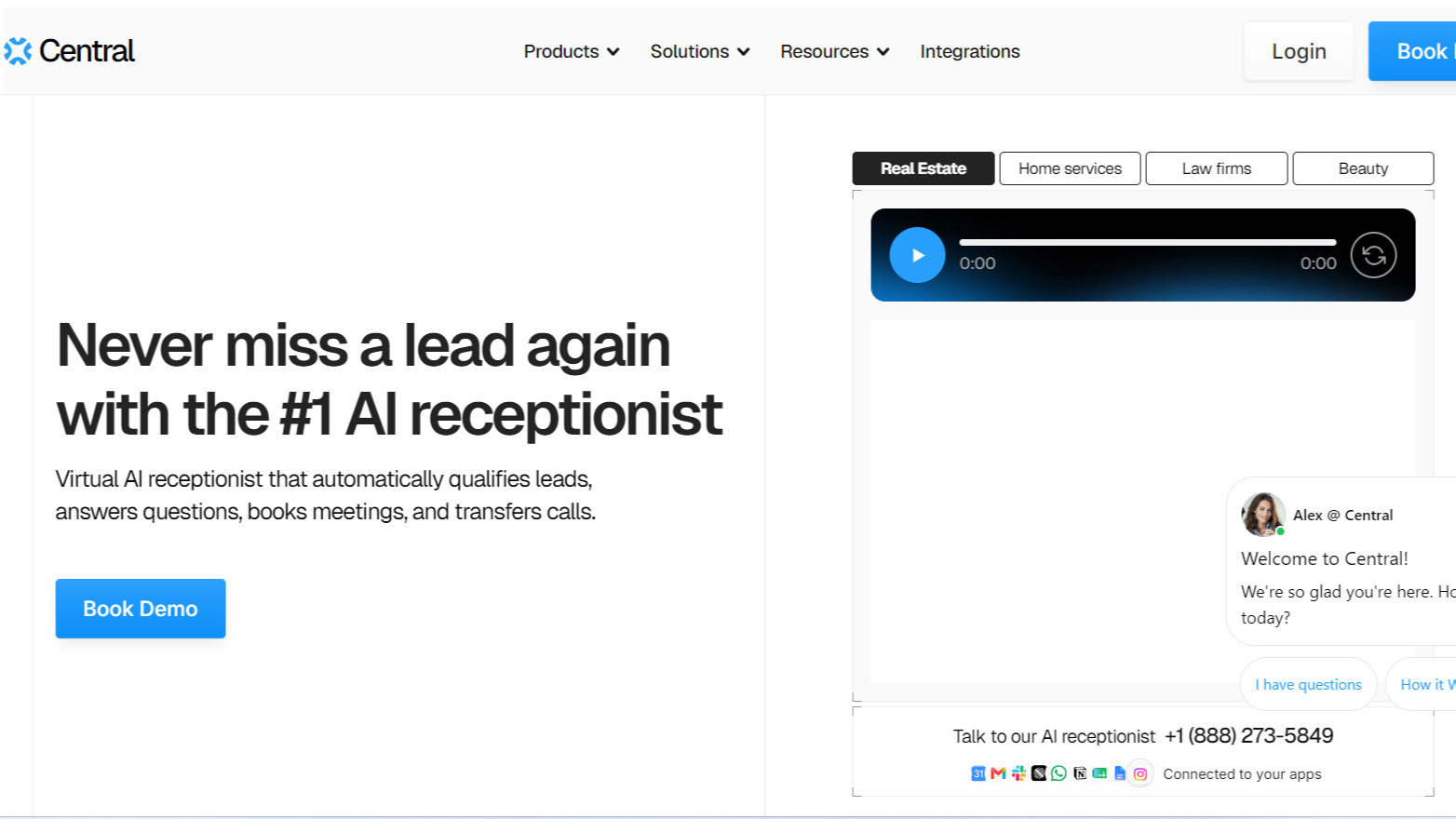
Central's FAQ puts the share of calls handled by the AI at 90 to 95 percent. The agent speaks more than 30 languages with automatic detection, handles unlimited simultaneous calls and includes a CRM at no extra cost so caller details, notes and follow-ups stay in one place.
Setup runs from your website URL. The platform connects to more than 6,000 tools through Zapier, and Central states that it integrates with major EMR and EHR systems to keep patient records current. Pricing starts at $89 a month for 90 calls, with a 10-day free trial.
Best for: practices whose problem is total front-desk load across calls and messages rather than deep specialty scheduling.
Verify before deploying: request the BAA and security documentation directly. Neither a BAA policy nor an independent attestation is published on the site, and no specific EHR is named.
2. Assort Health
Assort Health is the deepest of the four on EHR integration. It publishes more than twenty bidirectional integrations, naming Epic, Cerner, athenahealth, AdvancedMD, eClinicalWorks, NextGen, Nextech, ModMed and Greenway, and it runs specialty-specific scheduling logic rather than generic booking.
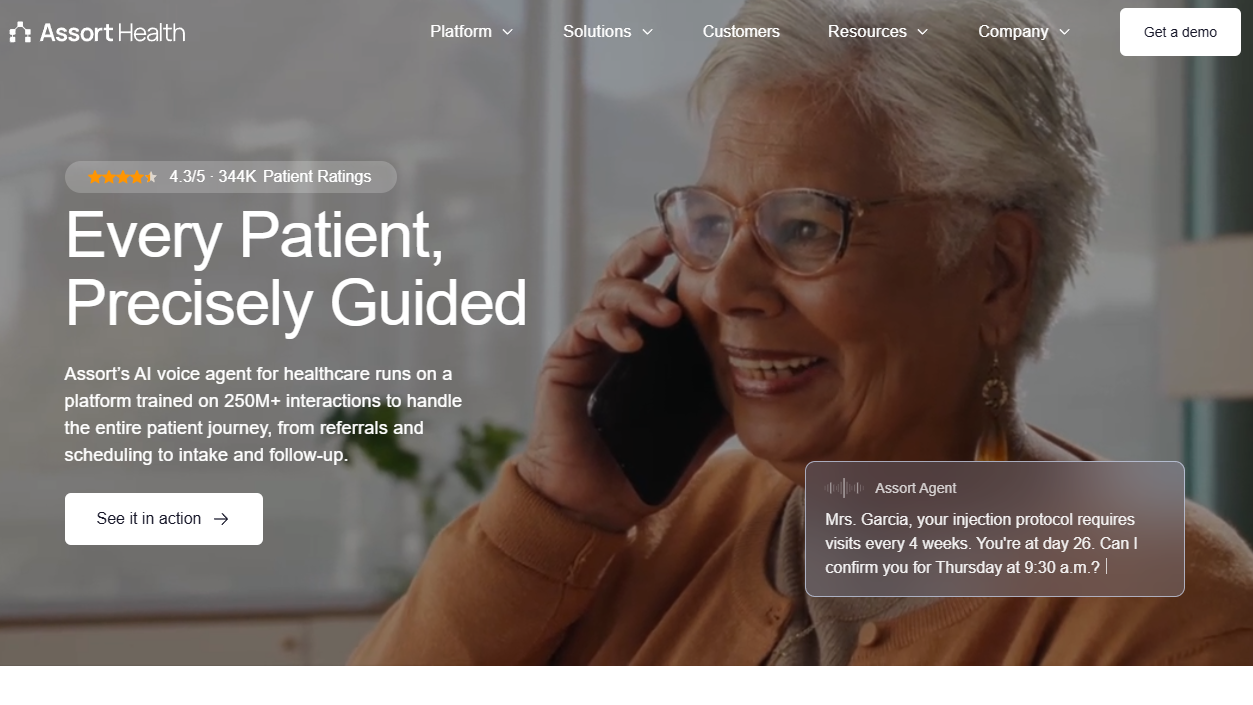
On compliance it is the most explicit vendor here. Assort states that it is HIPAA compliant and SOC 2 Type II certified, that it signs a BAA with every customer, that it maintains downstream BAAs across its subprocessor chain and that it provides full audit trails to compliance and IT teams.
Implementation is the trade-off. Assort says deployments typically go live in about six weeks, which reflects the depth of the EHR work rather than a slow process.
Pricing is not published. The company has raised a $120M Series C to expand its patient journey platform.
Best for: specialty groups and multi-site practices where the booking has to land correctly in the chart.
3. Talkie.ai
Talkie.ai handles scheduling, prescription refills, FAQs, new patient intake and call routing around the clock, and also places outbound reminder, confirmation and patient recall calls. It works across phone and text in more than 50 languages and is trained for over 30 specialties.
Its security documentation is the most detailed of the four. Talkie states that it is HIPAA compliant and SOC 2 Type II certified, independently audited with regular external security testing including penetration tests, that it signs a BAA with every US healthcare client and that its AI providers are contractually barred from training on customer data. That last point is rare and worth asking every vendor about.
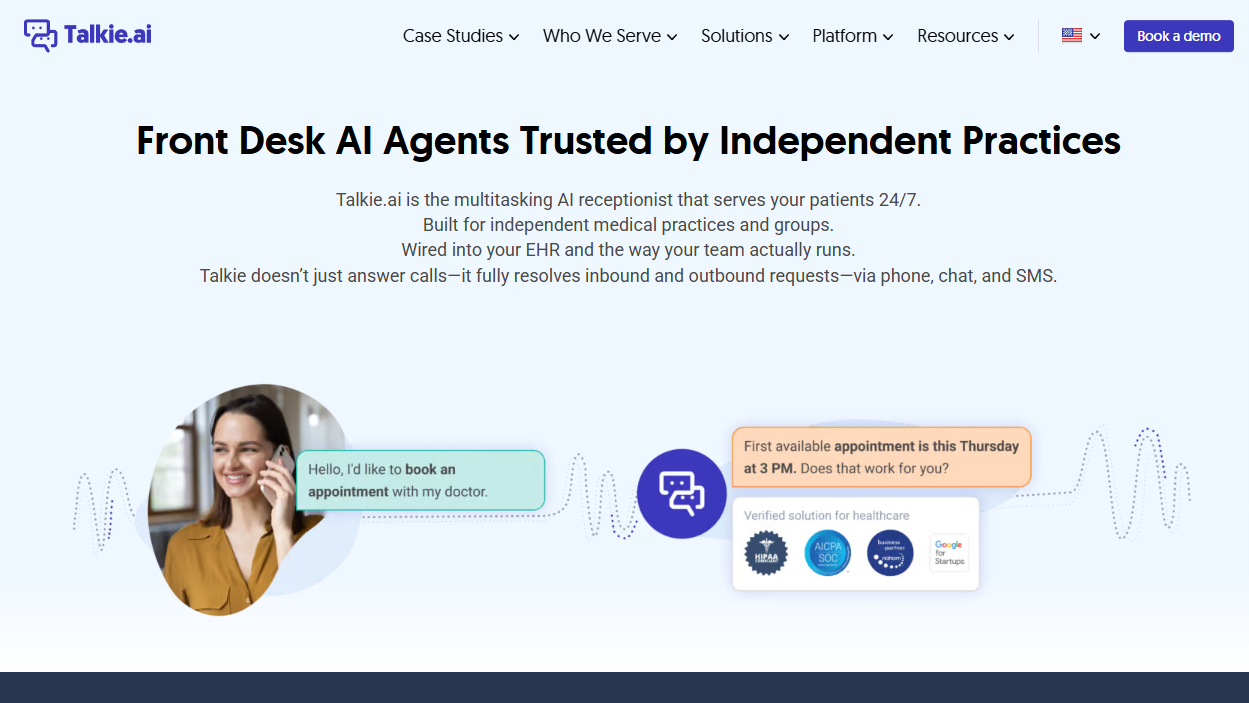
Native EHR integrations are named: athenahealth athenaOne, ModMed EMA, Elation Health, AdvancedMD and eMedicalPractice. Talkie is an official athenahealth Marketplace partner.
The clinical boundaries are stated too. Refill requests verify patient identity and medication details then route for provider approval rather than being approved by the agent, and callers describing a life-threatening issue are directed to emergency care. Pricing is not published.
Best for: primary care practices that want a focused call agent with explicit clinical boundaries.
4. Emitrr
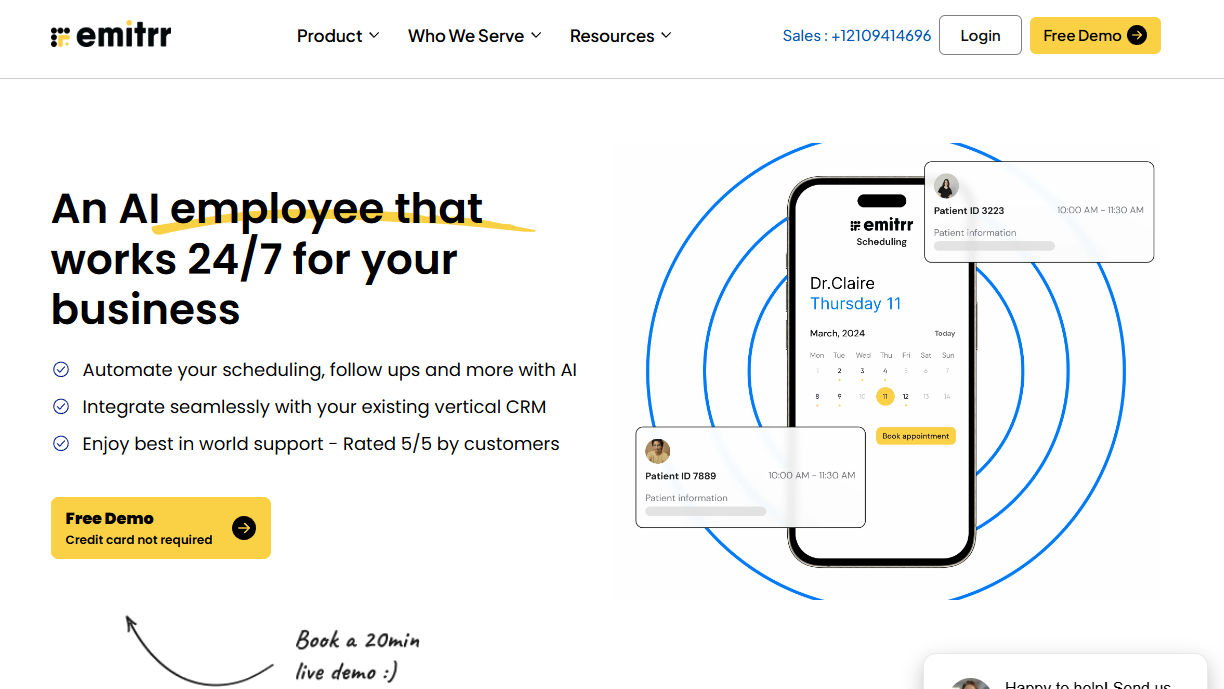
Emitrr pairs an AI voice agent with an AI SMS agent, a website chatbot and a VoIP phone system, so voice and text sit in one platform rather than two. It states HIPAA and TCPA compliance and cites integration with more than 500 EHR, PMS and CRM tools.
Its AI phone agent starts at $99 a month, the higher of the two published entry prices in this comparison. Emitrr reports ratings of 4.9 on Capterra and 4.8 on G2.
Best for: practices that want voice and text automation together with a VoIP phone system in one platform.
Verify before deploying: an independent attestation and a BAA policy are not published on the site, so request both.
What should a practice check before signing?
Ask for the BAA before the demo, not after. A vendor that cannot produce one on request should be off the list, and the agreement needs to cover the specific data flows in your deployment rather than a generic template.
Then ask about subprocessors. Most voice agents route audio through third-party speech and language infrastructure, and each of those needs its own downstream agreement. A badge at the top of a website does not cover that chain.
Ask whether your data trains anyone's model and get the answer in the contract. Only one of the four platforms above addresses this publicly.
Then test the escalation path with a real call rather than a scripted demo. Ring the vendor's live line, change the subject mid-sentence and see where you end up.
The same qualification discipline belongs on every intake channel, not just the phone. Practices that pair a voice agent with AI-powered lead forms on their website end up with one consistent standard for what counts as a qualified enquiry, whichever way it arrives.
The bottom line
The best HIPAA compliant AI receptionist is the one that will sign a BAA covering your workflow, book inside your actual EHR and escalate a clinical call without improvising.
Shortlist two, request both security packets and call both demo lines before you compare a single price.
Frequently asked questions
Is any AI receptionist actually HIPAA certified?
No. HIPAA has no certification programme, so any vendor describing itself as HIPAA certified is using marketing language. What exists is a signed BAA plus independent attestations such as SOC 2 Type II.
Do I need a BAA for an AI receptionist?
Yes, whenever the platform creates, receives, maintains or transmits protected health information on your behalf. Appointment details and patient names count, not only clinical data.
What is the difference between SOC 2 Type I and Type II?
Type I assesses control design at a single point in time. Type II tests whether those controls operated effectively across a period, usually several months, which is why it carries more weight.
Can a HIPAA compliant AI receptionist book into my EHR?
Some write back into the chart during the call, others only capture details for staff to enter later. Ask the vendor to name your specific EHR rather than accepting a general integration claim.
How much does a HIPAA compliant AI receptionist cost?
Published entry pricing in this category starts at $89 a month for 90 calls, with a second platform here listing $99 a month. Most healthcare-specific vendors publish no tiers at all and quote on call volume, specialty and integration depth instead.
About the Author