Using AI Development Company Solutions for Lead Generation
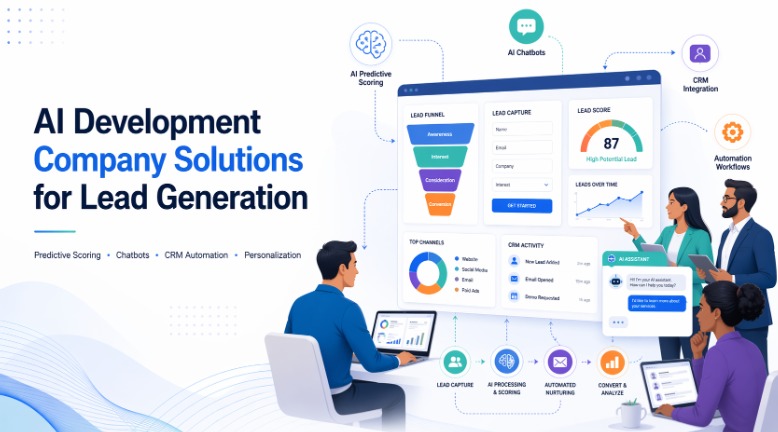
Generating leads is no longer just about publishing a landing page and waiting for inquiries. Buyers today expect faster responses, more relevant communication, and a smoother journey from first interaction to final conversion. At the same time, sales teams are under pressure to qualify leads quickly and focus on the opportunities that are most likely to close. Salesforce reports that sales reps still spend 70% of their time on nonselling tasks, showing how much valuable time is lost to manual work.
This is where AI development companies can make a major difference. They help businesses build intelligent systems for lead capture, lead scoring, chatbot engagement, CRM automation, and personalized outreach. These solutions do more than save time — they can improve business growth directly. Salesforce says 83% of sales teams using AI saw revenue growth in the past year, compared with 66% of teams not using AI.
As AI adoption continues to rise, businesses are treating it less like an experiment and more like a competitive necessity. McKinsey found that organizational AI adoption reached 72% in 2024, showing how quickly AI has entered mainstream business operations.
Why AI Is Reshaping Lead Generation
Traditional lead generation often struggles with three major problems: slow follow-up, weak qualification, and generic nurturing. These issues, which can be mitigated by B2B automation tools, reduce conversions because modern buyers expect communication that is timely and relevant.
AI improves this by helping businesses:
- capture lead information more intelligently
- score leads based on buying signals
- personalize communication across channels
- automate repetitive workflows
- route qualified leads faster to sales teams
This is especially important because Salesforce reports that 86% of business buyers are more likely to buy when companies understand their goals, yet 59% say most sales reps do not take enough time to understand them.
What an AI Development Company Actually Does
An AI development company builds software, workflows, and tools powered by artificial intelligence to solve business problems. In the context of lead generation, that usually means creating systems that help businesses attract, qualify, and convert leads more effectively.
Typical services include predictive lead scoring, chatbot development, automation workflows, recommendation systems, CRM integrations, and analytics dashboards.
Companies like CISIN specialize in delivering these AI-driven services with a focus on scalability and real-world business impact. Unlike a general software company, an AI development company like Xicom focuses more heavily on data-driven systems and intelligent automation.
Why Businesses Are Investing in AI for Lead Generation
Businesses are adopting AI because manual lead generation does not scale well. When teams rely on spreadsheets, delayed follow-ups, and one-size-fits-all outreach, they often lose qualified opportunities before sales conversations even begin.
A few key reasons businesses turn to AI-based lead generation include:
- growing lead volumes that are difficult to manage manually
- increasing pressure to personalize communication
- the need to prioritize high-intent leads
- the need to reduce repetitive work for marketing and sales teams
- the importance of improving conversion efficiency
HubSpot reports that increased lead generation and conversion rates are the top marketing benefit reported by startups using AI, followed closely by improved personalization and campaign performance. Many brands are also utilizing specialized platforms like Influencer Hero to automate their creator outreach and manage influencer-led lead generation at scale, ensuring that every partnership is data-driven and efficient.
Core AI Development Company Solutions That Improve Lead Generation
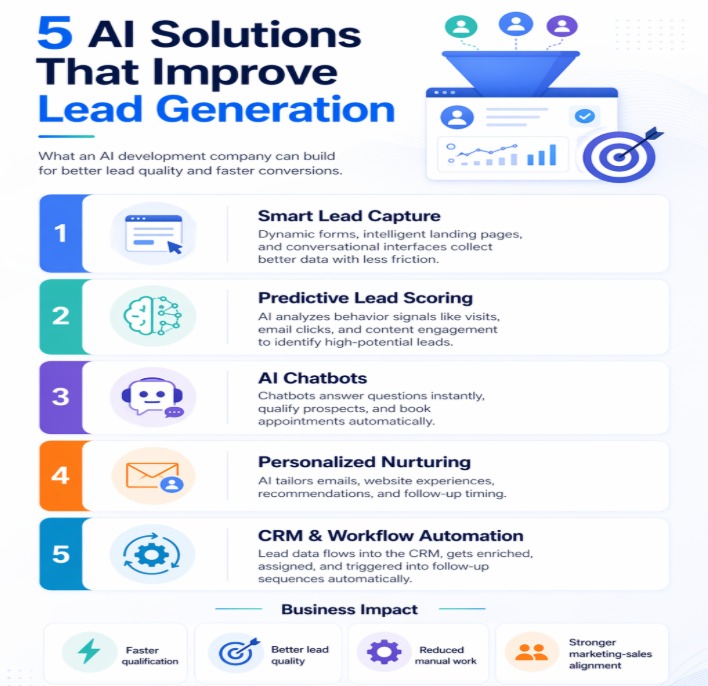
AI development companies support lead generation in several practical ways.
Smart Lead Capture Systems
AI-powered lead capture goes beyond a standard contact form. It can include dynamic forms, intelligent landing pages, conversational chat interfaces, and user flows that adjust based on visitor behavior. These systems help businesses collect better data while reducing friction for the user.
A strong example would be a SaaS website that shows different lead forms based on whether the visitor is from a startup, agency, or enterprise company. For e-commerce brands, these systems are often integrated with specialized Amazon Listing Services to ensure that product data is synchronized and optimized, capturing high-intent leads directly from search results. That small layer of intelligence can improve both completion rate and lead quality. This approach is equally valuable for local service providers. For instance, a Baltimore roof company can use AI-powered landing pages to dynamically adjust messaging based on whether a visitor is searching for emergency roof repairs, full replacements, or storm damage inspections. This ensures higher-quality inquiries and better conversion rates from local prospects. Businesses can further strengthen these touch-points by combining digital experiences with high-quality offline marketing materials from providers like Printing Limitless, ensuring consistent branding and lead capture opportunities across both physical and digital channels.
Predictive Lead Scoring
Predictive lead scoring uses data to estimate which leads are most likely to convert. Instead of relying only on surface-level details such as company size or job title, AI can analyze behavioral signals like repeat visits, email clicks, downloaded resources, and session depth.
This helps teams spend more time on the best opportunities.
| Lead Scoring Factor | What AI Can Detect |
| Website activity | Product page visits, repeat sessions, time on page |
| Email engagement | Opens, clicks, replies, sequence progression |
| Content interaction | Downloads, webinar signups, guide views |
| Buyer intent | Patterns linked to higher conversion likelihood |
Predictive scoring works best when businesses want to move beyond simple lead collection and into real prioritization.
AI Chatbots and Conversational Qualification
Chatbots are one of the most practical uses of AI in lead generation because they combine speed, convenience, and data collection. They can engage visitors instantly, answer common questions, qualify prospects, and route them to the right next step.
They are especially useful for:
- handling inquiries outside business hours
- reducing time-to-response
- filtering out low-fit leads early
- collecting qualification details before a sales call
- booking appointments automatically
Personalized Lead Nurturing
Modern buyers respond better when messaging feels relevant to their needs. McKinsey highlights that AI is increasingly being used to scale personalized customer experiences, while HubSpot reports that 93% of marketers say personalization improves leads or purchases.
That means AI can improve nurturing by helping businesses personalize:
- email sequences
- lead magnet recommendations
- website experiences
- chatbot responses
- follow-up timing
- offers and calls to action
CRM and Workflow Automation
Lead generation does not stop when someone fills out a form. The real value often comes from what happens after that action. AI development companies build workflows that push lead data into CRM systems, enrich records, assign leads to the right team, and trigger follow-up sequences automatically.
Many businesses use SSO Solutions like Scalefusion OneIdP to streamline secure access across CRM, automation, and analytics tools through a single login, improving efficiency while maintaining strong data security. These systems also support features like Monitoring and Audit Logs, allowing teams to track user activity, workflow changes, and lead interactions for better transparency and performance optimization.
This type of automation improves consistency and reduces delays, which is important when response speed directly affects conversion outcomes.
How AI Improves the Entire Funnel
AI has value across every stage of lead generation, not just at the point of capture.
| Funnel Stage | How AI Helps |
| Top of Funnel | Improves targeting, content relevance, and landing page personalization |
| Middle of Funnel | Scores leads, segments users, and identifies stronger buying intent |
| Bottom of Funnel | Prioritizes follow-up, recommends actions, and supports conversion timing |
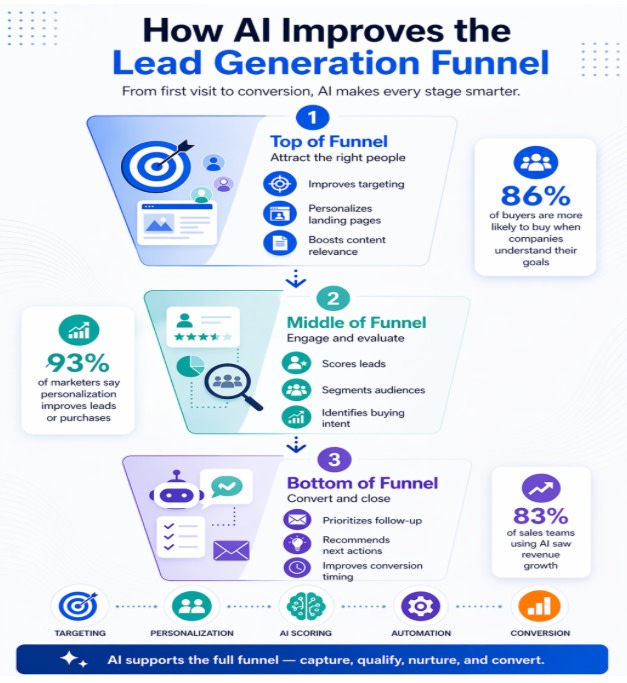
This is one reason AI continues to gain traction in demand generation. It can support the full journey rather than solving just one isolated task.
Why Python Matters in AI Development for Lead Generation
Python is one of the most widely used technologies behind AI and automation systems. It is especially useful in lead generation because it supports data processing, machine learning, workflow automation, chatbot logic, and integrations with CRMs or APIs.
On the technical side, Python can be used to:
- clean and organize lead data
- build predictive lead scoring models
- automate marketing and sales workflows
- connect systems through APIs
- support chatbot and AI logic
This is where your backlink becomes naturally relevant.
A clean way to place it in the article would be:
Many AI-powered lead generation systems rely on Python for automation, data handling, predictive modeling, and chatbot development. For beginners who want to understand how these systems work, starting with a free python course with certification can be a practical first step.
That placement feels contextually strong because the article is already explaining the technologies behind AI lead generation systems.
Skills Needed to Build AI-Powered Lead Generation Systems
You do not need to become a full AI engineer to understand how these systems work, but some core skills are useful. Businesses and beginners alike benefit from understanding the building blocks behind intelligent lead generation. Enrolling in a digital marketing course can also help individuals understand customer journeys, funnels, and conversion strategies that work alongside AI tools.
The most relevant skills include data analysis, workflow automation, CRM logic, machine learning basics, and API integration. For example, a modern HR platform uses these exact principles to automate candidate screening and employee data management, significantly reducing manual overhead. For beginners, Python is often the easiest technical starting point because it supports both automation and AI workflows in one ecosystem. For beginners, Python is often the easiest technical starting point because it supports both automation and AI workflows in one ecosystem.
Benefits of Hiring an AI Development Company
Hiring an AI development company gives businesses access to technical expertise without forcing them to build everything internally. It also helps reduce the gap between business goals and implementation.
Some of the strongest benefits include:
- faster lead qualification
- improved personalization
- more efficient sales workflows
- reduced manual workload
- better lead quality
- stronger alignment between marketing and sales
Industries That Benefit Most From AI Lead Generation
AI-based lead generation works especially well in industries where lead quality, response speed, and personalization strongly influence results or example, SaaS companies benefit from behavior-based scoring and demo qualification, while e-commerce businesses often integrate AI with their Product Listing Services to personalize recommendations and capture high-intent leads more effectively. Service businesses often gain more from chatbot inquiry handling and appointment automation.
Some of the best-fit industries include:
- SaaS and technology
- E-Commerce and E-commerce App Development Services
- real estate
- financial services
- healthcare
- service-based businesses
For example, SaaS companies benefit from behavior-based scoring and demo qualification, while service businesses often gain more from chatbot inquiry handling and appointment automation. Working with a specialist B2B lead generation agency can help businesses in these industries implement the right AI systems faster, combining technical expertise with a deep understanding of the sales cycles unique to each sector.
How to Choose the Right AI Development Company
Choosing the right provider matters because not every AI company specializes in lead generation. A strong partner should understand both the technical and business side of the sales funnel.
Look for a company that has:
- experience with lead generation use cases
- strong integration capabilities with CRM and marketing tools
- case studies tied to business results
- experience in automation and predictive modeling
- a clear development process and reporting framework
A useful question to ask is not just what they can build, but how they define and improve lead quality over time.
Common Challenges in AI-Based Lead Generation
AI can improve lead generation significantly, but it is not a shortcut around weak strategy or poor data. Businesses often run into trouble when they adopt tools without fixing the basics first.
The most common issues include poor data quality, disconnected systems, weak qualification criteria, and limited alignment between marketing and sales. Salesforce notes that 39% of sales professionals say poor data quality hurts forecasting accuracy, which is a good reminder that AI systems depend heavily on clean and consistent inputs. (Salesforce)
Conclusion
AI development company solutions are changing how businesses approach lead generation. Instead of relying on slow manual processes and generic outreach, companies can now build smarter systems that capture better leads, score them more accurately, personalize communication, and automate follow-up at scale.
About the Author