How Agentic Checkout Reduces Checkout Friction
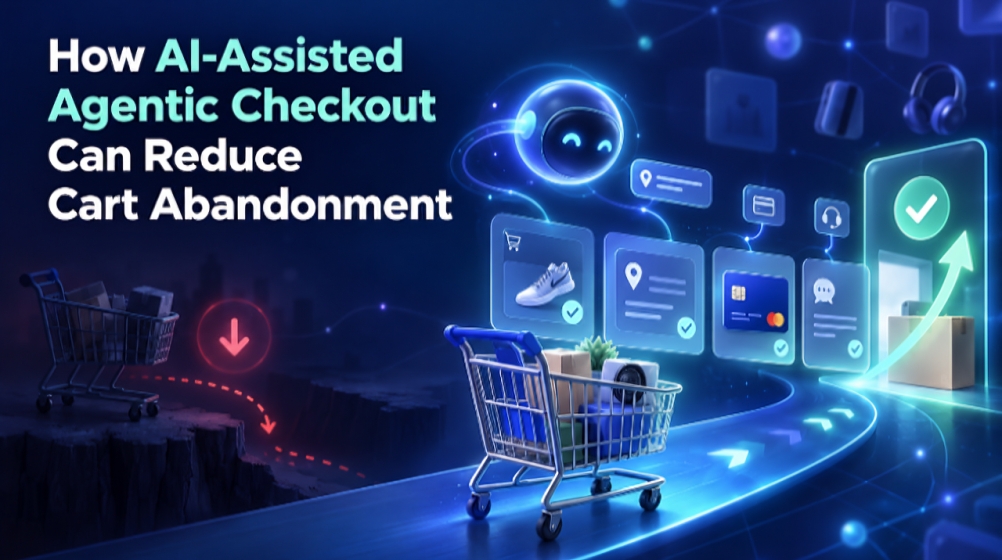
Business owners and founders always seem to know how many shoppers abandon their carts. But before AI, they couldn’t clearly know the reason and also didn’t have any way to stop them from bouncing off.
2026 is shaping up differently as we are now using AI in almost every aspect of building a business, and why should the checkout part stay behind? Agentic AI solutions have made the checkout experience smarter because it is starting to act less like a form and more like an assistant that is actually paying attention to what's going wrong, in real time, before the customer bounces.
Why is the Cart Getting Abandoned Anyway?
Before fixing anything, it helps to be honest about where the leak actually is. Most stores are still losing customers to problems that were solvable years ago.
i. Unexpected Costs: Shipping fees, taxes, or a "convenience charge" that shows up on the last screen doesn’t bode well with customers. They did the math in their head at the product page, but if the amount at checkout is different, it creates a gap, which breaks trust, driving the customer away.
ii. Forced Account Creation: "Sign up to continue" is still, somehow, a checkbox on a lot of checkout flows. Buyers are not ready to commit to this before they have made their first purchase and received the product or service.
iii. Slow Checkout: In the checkout form, every additional field, an extra page asking more information from buyers and every redirect to a payment page that takes even two more seconds causes a rift in the decision making process. These extra 2 seconds are enough for the customer to talk themselves out of the purchase.
iv. Trust Deficiency: Customers will want to ensure the website they are visiting is secure. So for a brand with a website without any security badges, an unfamiliar payment brand, and a checkout URL that looks different than others raises a doubt. Doesn't matter how good the product photos were; if the last screen feels unsafe, the cart gets abandoned.
These are old problems, well-documented, and most stores have partially fixed one or two of them. What's changed in 2026 is that AI can now sit inside the checkout flow and address several of these simultaneously, live, and personalise the solutions for each customer.
How Does Agentic Checkout Eliminate Friction For Your Customers?
Agentic checkout means the checkout isn't a static form anymore, but it's an active layer that observes behaviour and takes a proactive approach to ensure the customers complete the transaction in a way the store salesperson would if they were standing next to the customer.
i. Real-time Doubt Resolution: Instead of a static FAQ link, an AI layer can answer "is this returnable" or "does this ship to my pincode" right there on the payment screen, without the customer opening a new tab and losing the buying momentum.
ii. Automated Multi-step Checkout Optimisation: The system rearranges or skips steps depending on the customer; a returning customer with their details already saved in the system doesn’t need to go through the same process as a first-time buyer. This means that for repeat purchases, there are even fewer decision points, fewer chances to leave.
iii. Intelligent Personalisation: Agentic AI systems can customise the payment method ordering, offer visibility, and even the language of the CTA according to the customer’s checkout preferences and the type of device they are using.
iv. Proactive Hesitation Detection: AI notices subtle behaviour or interaction changes like the mouse hovering over the "back" button, an unusual pause before the payment step, or multiple repeated field edits, etc. As the AI systems start to interpret these hesitations, they respond before the tab closes, not after.
v. Predictive Incentive Optimisation: Instead of a blanket 10% off for everyone, the system estimates who actually needs a nudge to convert and who was going to buy anyway, and shares the discount codes or even offers it to buyers according to the situation.
vi. Conversational Cart Re-engagement: When someone does leave, the follow-up isn't a generic "you left something in your cart" email three hours later. It's a contextual nudge built with smartness and situational awareness. The re-engagement response is sometimes conversational, sometimes just well-timed.
Prepare Your Online Store for Agentic Checkout
Agentic checkout needs a foundation, and most stores don’t have the required foundation yet. So, here’s how to prepare your store for Agentic checkout.
Audit Your Checkout Flow For Automation Readiness
Map every step, every field, every redirect in the checkout flow to ensure you are not asking your customers to take an extra step. If a human can't explain why a step exists, an AI system definitely can't optimise around it. Start by removing dead weight before adding intelligence on top.
Integrate Structured Product Data
Agentic systems, whether it's an AI answering a product question or a conversational agent completing a purchase on a customer's behalf, need clean, structured data to work from. Loose descriptions and inconsistent variants quietly break automation before it starts.
Invest In AI-Friendly Payment Gateways
A lot of "AI checkout" projects stall not because the AI layer is weak, but because the payment infrastructure underneath it can't keep up. Payment gateways with slow settlement, patchy success rates, or a gateway that wasn't built to handle the kind of dynamic, high-frequency decisioning agentic flows cannot fit into an AI-enabled checkout experience.
Agentic payments gateways like Cashfree earn their place in the stack rather than just sitting in it, as they offer the following key features;
i. Multi-bank routing that keeps success rates high during traffic spikes.
ii. T+1 settlement means the cash from today's automated conversions is actually usable tomorrow, not locked up while your ad spend needs it.
iii. Native integrations across Shopify, WooCommerce, and Wix mean the payment layer doesn't become the bottleneck when everything else in the checkout stack is moving toward real-time, AI-assisted flows.
Build Trust With Your Customers
No amount of automation fixes a checkout experience, and a store customers don't trust. Visible security signals, transparent pricing before the last screen, and a support path that doesn't feel like a dead end are still the core tenets of building a customer-friendly checkout experience, regardless of the agentic systems.
Conclusion
Cart abandonment was never really a checkout design problem; it's a decision-fatigue problem, and static forms were never going to solve it.
Agentic checkout is the first real shift because it treats every cart abandonment as a solvable, individual moment instead of an aggregate statistic to optimise against.
Even when we have AI systems to solve the checkout problems, cart abandonment will not disappear in 2026. But AI and agentic systems will certainly bridge the gap between added to cart and paid finally starts. If you are rethinking what's underneath that checkout flow, it's worth starting with the payment layer.
About the Author