The State of Jewelry Ecommerce in 2026
Online jewelry sales continue to grow, but customer expectations grow even faster. Shoppers compare dozens of stores before making a high-value purchase. They expect flawless visuals, smooth customization, and complete trust signals.
Modern jewelry ecommerce demands performance, flexibility, and security working together. So brands mostly partner with a professional jewelry web design company that understands complex product logic and premium UX standards.
This guide explains how to build a jewelry ecommerce website that converts in 2026, what challenges to prepare for, and how much you should budget.
Key Features for a User-Friendly Jewelry Website in 2026
The online jewelry market demands features that combine virtual browsing and the tangible beauty of the product.
Advanced Product Visualization
Jewelry's allure is in its detail. Therefore, your website must offer:
- HD photography: show accurate color and texture
- 360-degree view: display every angle
- Zoom function: highlight stone clarity
- Video preview: demonstrate shine and movement
A virtual try-on feature would be a huge benefit for your customers and stand your business out among the competitors. This technology is a game-changer. An impressive 75% of consumers express a desire for augmented reality (AR) features to virtually try on rings, necklaces, or earrings.
Smart Filtering and Navigation
Customers should find the right item within seconds. For this purpose, your team should create a clear website structure:
- Filters: narrow by metal, gemstone, price, occasion
- Categories: separate engagement, wedding, fashion
- Size options: allow quick ring size selection
- Sorting tools: organize by popularity or price
Once created, this structure shouldn’t stay an unshakable granite cliff. It must be adjusted regularly in accordance with customer feedback and analytics data.
Customization Tools
Modern buyers expect personalization. However, this goes beyond simple "you might also like" recommendations – though those are effective if based on actual behavior rather than random items. Personalization also includes:
- Jewelry configurators: Let users combine settings and gems
- Engraving features: Allow for custom text
- Personalized discounts: Offer tailored deals that calculate correctly and drive repeat purchases
That said, remember that a complicated customization flow increases abandonment. Keep steps intuitive and transparent.
Mobile-First Experience
With over 60% of online jewelry sales now occurring on mobile devices, your website must be flawlessly responsive and optimized for smartphones and tablets. Jewelry websites must support:
- Thumb-friendly menus
- Fast-loading galleries
- One-page checkout
- Autofill payment forms
Trust and Security Elements
Given the high value of jewelry, robust security is non-negotiable. Customers must feel absolutely safe when making a purchase.
Visible trust elements that remove hesitation during checkout include:
- SSL security: protects transactions and data
- Certifications: displayed GIA or IGI documentation
- Reviews: verified buyer feedback to build social proof
- Clear policies: transparent explanations of shipping and returns
Modern Jewelry Store: Must-Have Features Examples and Their Benefits
Below is a breakdown of key technological integrations and their direct impact on customer satisfaction and sales performance.
| Feature | Purpose | Impact on customer experience and sales |
|---|---|---|
| High-resolution zoom | Enables close-up inspection of intricate details | Recreates the in-store examination experience |
| Detailed product specifications | Provides comprehensive information on materials, carat weight, dimensions, and certifications | Educates customers, reduces perceived risk |
| Virtual try-on (AR) | Allows customers to visualize jewelry on themselves using their device's camera | Reduces returns by up to 35%, increases confidence |
| AI chatbots | Provides instant, 24/7 customer support, answers FAQs, and guides product discovery | Improves customer satisfaction and conversion rates |
| Personalized recommendations | Uses AI to suggest products based on browsing history and preferences | Increases average order value and customer engagement |
| Blockchain integration | Verifies the authenticity, origin, and ethical sourcing of gemstones and metals | Builds immense trust, crucial for high-value items |
Benefits of a Well-Built Jewelry Website
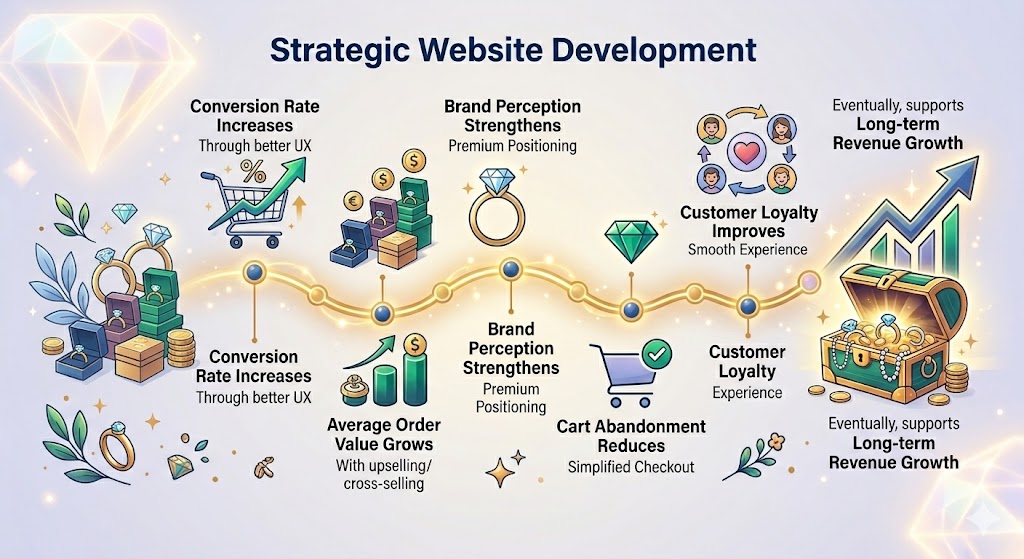
Strategic development delivers measurable results:
- Conversion rate increases through better UX
- Average order value grows with upselling
- Brand perception strengthens premium positioning
- Cart abandonment reduces through simplified checkout
- Customer loyalty improves via smooth experience
Eventually, a high-performing website supports long-term revenue growth.
Challenges in Jewelry Ecommerce
While the opportunities are vast, specific challenges come with selling high-value, intricate products online.
- Building trust at a distance. Customers often have concerns regarding gemstone authenticity, metal purity, and the security of high-ticket deliveries.
- Conveying detail and brilliance. Replicating the physical sparkle and intricate craftsmanship of jewelry through a screen is difficult.
- Shipping and insurance risks. High-value items require specialized, insured shipping and robust tracking systems, which can be both costly and logistically complex.
Additionally, jewelry ecommerce often requires advanced backend logic that introduces further technical demands:
- Complex database management. Configurable products with multiple variations must sync perfectly with real-time inventory.
- Performance vs. visuals. Large, high-resolution images can degrade site speed; developers must implement advanced compression without sacrificing visual quality.
- Interactive tech. Integrating 3D viewers and virtual try-on features requires significant development resources and rigorous testing.
Finally, because jewelry keywords carry high search volume and intense competition, a sophisticated SEO strategy is essential for visibility.
The Cost of Building Your Jewelry Site in 2026
Project costs vary significantly based on your specific feature requirements and platform choice.
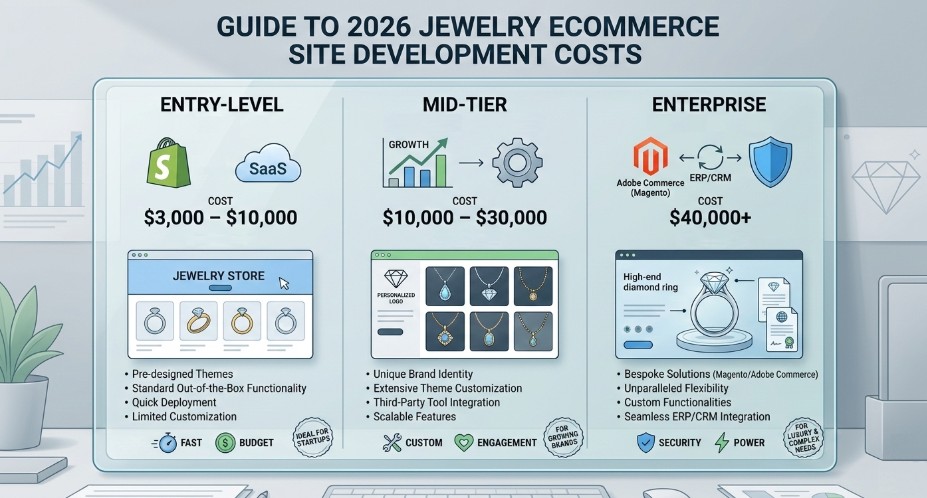
- Entry-Level (Shopify/SaaS): $3,000–$10,000
Ideal for startups or businesses with limited budgets. Using pre-designed themes and standard out-of-the-box functionality allows for quick deployment, though customization options remain limited.
- Mid-Tier (Growth & Customization): $10,000–$30,000
Designed for growing brands seeking unique identity and specific integrations. This involves extensive theme customization and the implementation of specialized third-party tools.
- Enterprise (Bespoke Solutions): $40,000+
For luxury brands or businesses with complex operational needs, bespoke solutions (such as Magento/Adobe Commerce) offer unparalleled flexibility. These projects provide custom functionalities and seamless integration with ERP or CRM systems.
Estimated Costs by Component
The following table outlines the average price ranges for different development stages when partnering with an expert jewelry e-commerce agency.
| Component | Estimated Cost Range |
|---|---|
| UX/UI design | $3,000–$8,000 |
| Development | $5,000–$50,000 |
| Custom module development | $1,000–$10,000 per unit |
| Third-party module integration | $100–$1,000 per unit |
| Ongoing maintenance | $500–$3,000 per month |
Conclusion
Creating a user-friendly jewelry e-commerce website in 2026 is an intricate process that demands attention to detail, a focus on cutting-edge technology, and an unwavering commitment to customer trust. Technical execution matters as much as design. When you invest in performance, trust, and personalization, you create a digital showroom that converts visitors into loyal customers.
About the Author