Survey Questions to Understand Your Customers (+ Templates)
Many companies recognize the importance of understanding their clients, yet they often struggle to put effective communication into practice.
This difficulty usually stems from a failure to solicit customer feedback, making it harder to reflect and improve. If you’re not asking the right questions, you’re missing the first step in fixing these challenges.
Creating a strategic survey allows you to gather customer inquiries, provide excellent service, and inspire enthusiasm for your business.
Defining your survey goals
Before drafting your questions, you must define the survey’s objective. Ambiguous surveys generate data that’s difficult to manage and track.
Establish a clear objective to ensure you’re providing the needed assistance to your support team and your clients:
- Product development: Use product feedback questions to identify which features help users and which create friction.
- Customer retention: Use feedback to detect dissatisfaction before consumers depart for a competitor.
- Market positioning: Learn why your target market chose your company over others in the industry.
- Service evaluation: Measure how well your customer support department is handling inquiries.
Types of customer surveys (with templates)
Designing effective surveys requires selecting the right format for your specific goals. While some businesses prefer detailed discussions, online forms are the most efficient way to gather data at scale.
Below are the primary survey types and how to structure them. Each format serves a different purpose depending on where the customer is in their journey and what type of feedback you want to collect.
Customer feedback form
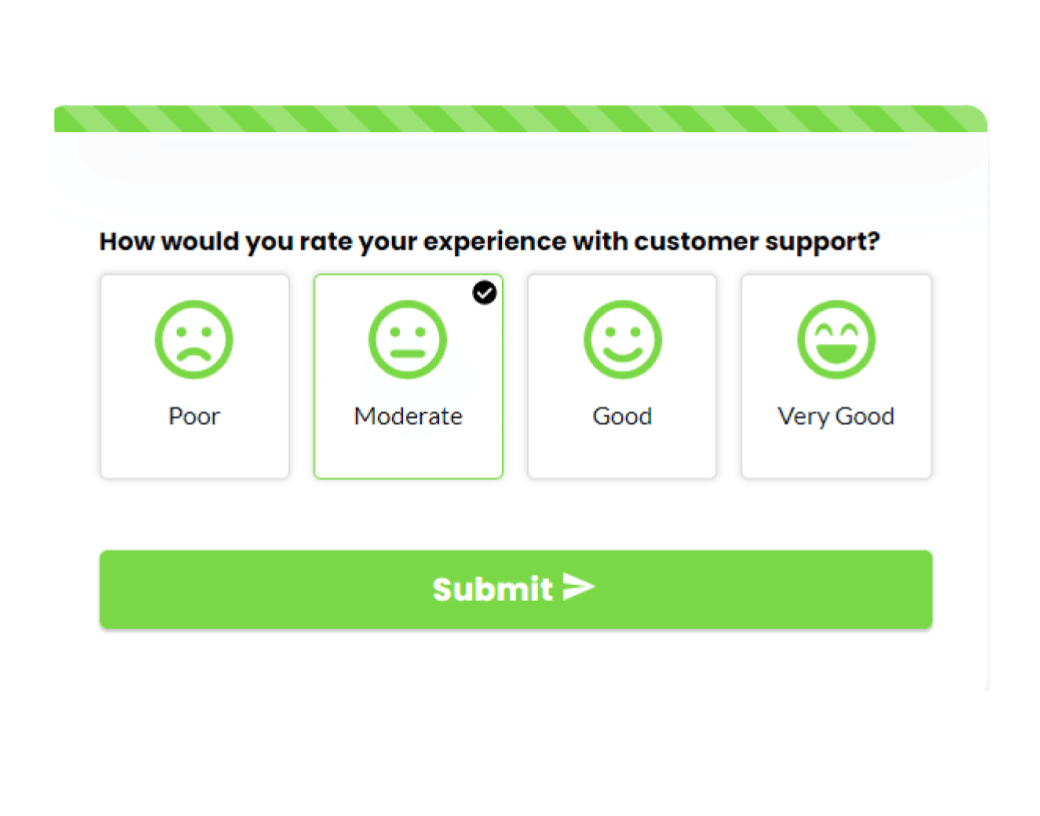
A standard feedback form is a versatile tool for any company. It provides a dedicated space for users to report problems, suggest improvements, or compliment your service.
By providing a clear channel for communication, visitors can easily share their thoughts without opening a formal ticket.
NPS survey form
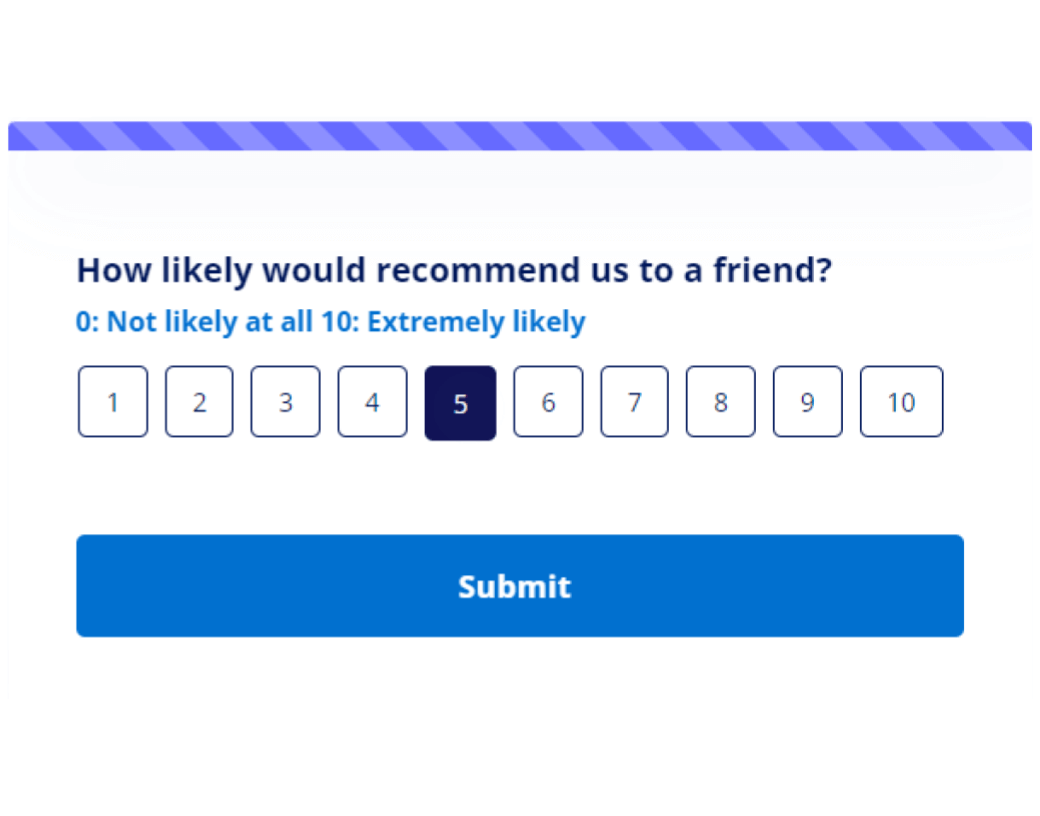
The Net Promoter Score (NPS) is a standard for measuring customer loyalty. It consists of a single, powerful question that categorizes your users into promoters, passives, or detractors. Because it’s brief, it typically sees high completion rates.
Satisfaction survey
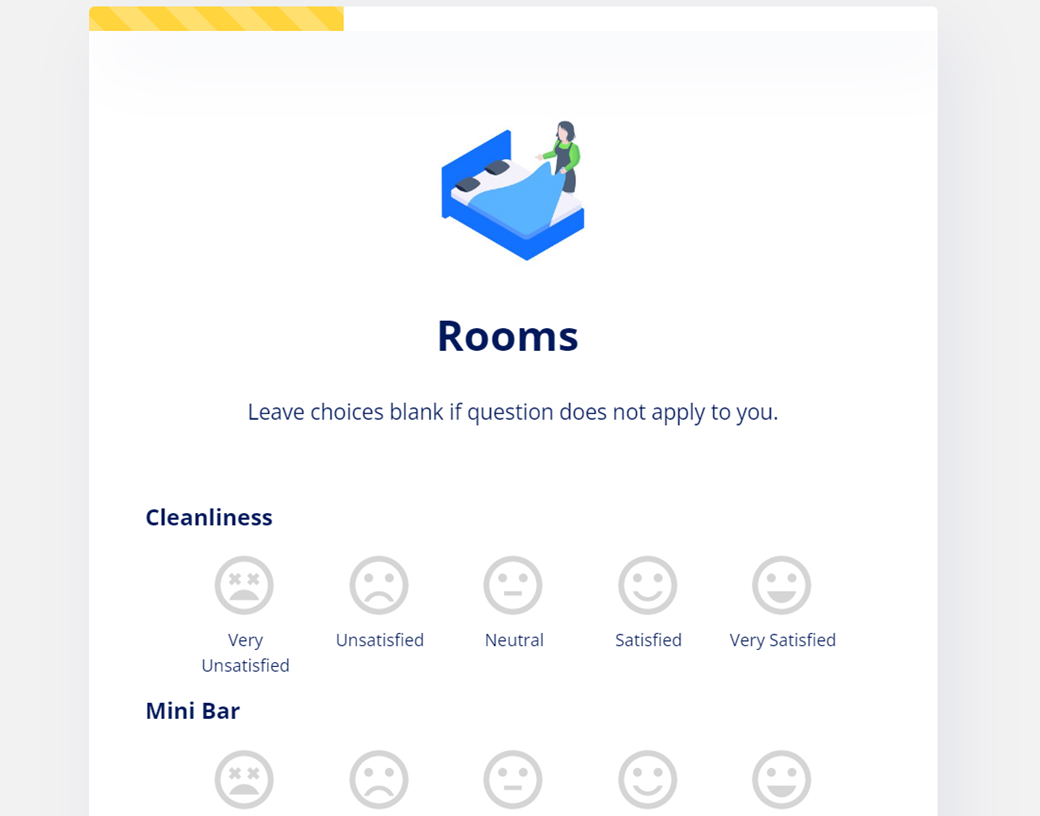
A satisfaction survey measures a user’s sentiment regarding a specific interaction, such as a recent purchase or a conversation with a representative.
These are often sent immediately after an event to capture feelings while the experience is fresh.
High-impact questions to ask (the must-haves)
You want to make it as simple as possible for users to provide feedback. Using a mix of the question types ensures you get the highest signal.
Here are some survey question examples to include:
The problem-solver
“Which specific challenge were you trying to solve when you first found our business?”
This reveals the primary pain point driving your customers. Knowing the “why” behind the purchase helps you refine your marketing messaging to target similar leads.
The value-driver
“What task can you complete now that was previously impossible?”
This identifies your product’s “Aha!” moment. Understanding the specific utility of your service allows you to highlight your most valuable features in sales demos.
The effort check
“On a scale of 1–10, how easy was it to find what you needed today?” This helps determine your customer effort score (CES).
High effort leads to low retention. This question helps calculate your customer effort score and points to friction in your user interface or service process.
The competitor-check
“If our solution were no longer available, what would you miss the most?”
This determines your unique selling proposition (USP). It tells you exactly what customers value about you that they can’t easily find elsewhere.
The loyalty metric
“How likely are you to recommend us to a colleague?”
This is the basis for your Net Promoter Score. It’s a reliable indicator of long-term growth and brand advocacy.
The feature-validator
“Which feature do you use most frequently in your daily workflow?”
This helps you prioritize your development roadmap. You can focus resources on maintaining the features that drive daily engagement rather than on those that are rarely used.
The friction-finder
“What is the one thing that nearly stopped you from completing your purchase or sign-up?”
This uncovers silent killers in your conversion funnel, such as confusing pricing, technical bugs, or a lack of trust signals.
The clarity test
“After using our solution, how clearly do you understand the value it provides to your team?”
If users don’t understand your value, they won’t renew. This gauges whether your onboarding process effectively communicates the product's benefits.
The comparison point
“Compared to other solutions you have used, is our product more or less complex to navigate?”
This provides a direct benchmark against your competition. It helps you understand whether you’re winning with simplicity or losing to a steep learning curve.
The future focus
“If you could design one new capability for our product, what would it be and why?”
This turns your customers into a focus group. It reveals unmet needs and can spark ideas for your next major product update.
How to structure your survey for higher response rates
Complicated surveys generate annoyance and lead to lower response rates. Use these design choices to keep visitors within their comfort zone:
- Limit response options: When using dichotomous questions (Yes/No), keep the choice clear to avoid survey bias.
- Use scaled responses: For measuring sentiment, Likert scale questions provide a nuanced view of customer satisfaction.
- Start simple: Use multiple-choice selections for the first few questions to build momentum before introducing open-ended questions.
- Optimize for mobile: Check that all fields and buttons perform properly on mobile devices.
- Include progress bars: Allow users to see how many steps remain, encouraging them to finish the process.
Once you’ve structured your questions and optimized the survey flow, the final step is putting these insights into action.
Start building better surveys
Understanding your customers is a continuous process of gathering and acting on feedback. Great surveys remove the guesswork from business decisions and provide a roadmap for product growth and improved retention.
LeadGen App helps you create professional, mobile-responsive survey forms in minutes. Choose from our expert-designed templates and start gathering the feedback you need to scale.
Try LeadGen App today to reduce friction and improve your customer experience.
About the Author