Where Video-to-Lead Funnels Lose Prospects
A video can rack up hundreds of thousands of views and still generate zero leads. Marketers celebrate the view count, then quietly wonder why the pipeline didn't move. The uncomfortable truth is that a great video only does half the job. The other half - the one nobody budgets time for - is what happens in the ten seconds after the video ends, when a viewer either fills out a form or closes the tab.
This is the story of a fintech commercial built in 10 days, and the harder lesson buried inside it: the form is not an afterthought bolted onto the end of a video. It's the second half of the same conversion event, and most teams design it like an afterthought anyway.
The Brief: A Commercial With No Room for a Second Draft
Lava Media - a video marketing agency - was brought in by a major bank with a deadline that left zero margin for a reshoot: a new joint-account feature needed a polished 30-second commercial for the big screens at a business forum where the bank had just secured a sponsorship slot. Production window: a week and a half.
The team pitched five distinct creative concepts before the client landed on a minimalist direction: a young couple, everyday household purchases, a story told through small visual beats rather than a feature list. What's worth noting for anyone thinking about speed and quality as opposing forces: tight timelines like this are increasingly common, partly because production discipline has gotten sharper, and partly because tools like AI-generated video now let teams test more creative directions in the same compressed window instead of committing early and hoping.
But speed wasn't the most interesting decision on this project. The most interesting decision was what the team refused to speed up.
Why the Team Chose Actors Over AI - On Purpose
Watch the commercial at the 6-second mark and you'll see the actress's face as she looks at a dessert on her phone. It's a small, specific expression - the kind of micro-smile that reads as "I am dreaming about this" without a single word of dialogue.
That expression is the reason the team shot with live actors instead of generating the scene with AI. Not because AI couldn't produce a smiling woman holding a phone - it can, easily. But it produces a generic smile, the kind that reads as "acting happy" rather than "actually wanting something." For a 30-second spot where the entire emotional payload rides on one facial beat, that gap matters. If you're evaluating where AI genuinely earns its place in a production pipeline and where it still falls short of a real performance, Lava Media's breakdown of AI video work is a useful place to see that line drawn project by project, rather than in the abstract.
The point isn't that AI video is bad. It's that every production decision - actor versus avatar, live footage versus generated scene - is really a conversion decision in disguise. The team that made this commercial understood that the video's job was to earn an emotional reaction, and every shortcut that would have blunted that reaction got rejected, even under a 10-day deadline.
Most teams apply that same rigor to the video and then completely drop it the moment the video ends and the form begins.
The Data Nobody Talks About: What Happens After the View
Here's the number that should be reshaping how marketers brief their video projects, and almost never does: a lead capture form embedded directly in video converts at 25% on average. Place that same lead capture form in the last quarter of a 1–3 minute video, and conversion climbs to 58%.
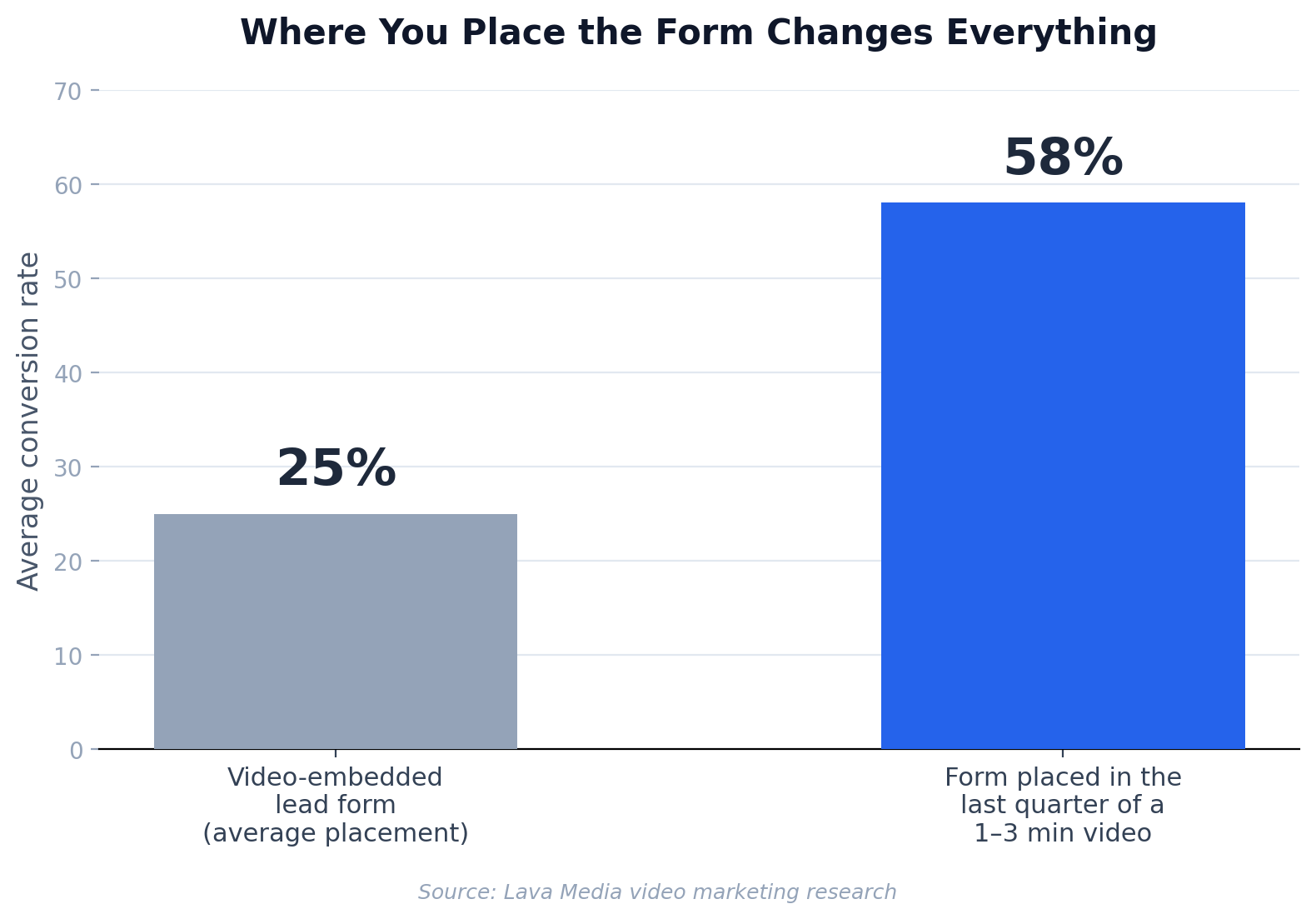
That's not a small optimization. That's more than double the conversion rate, from a placement decision that costs nothing extra to produce. The video is identical. The message is identical. The only thing that changed is when the viewer is asked to act relative to how emotionally invested they already are.
This is the piece most video-marketing conversations skip entirely. Everyone argues about hook rate, watch time, and production value. Almost nobody asks: once someone has watched the whole thing and is primed to act, does the very next thing they see make that action easy, or does it make them work for it?
Where Video-to-Form Funnels Actually Leak
Picture the funnel a viewer travels through, end to end:
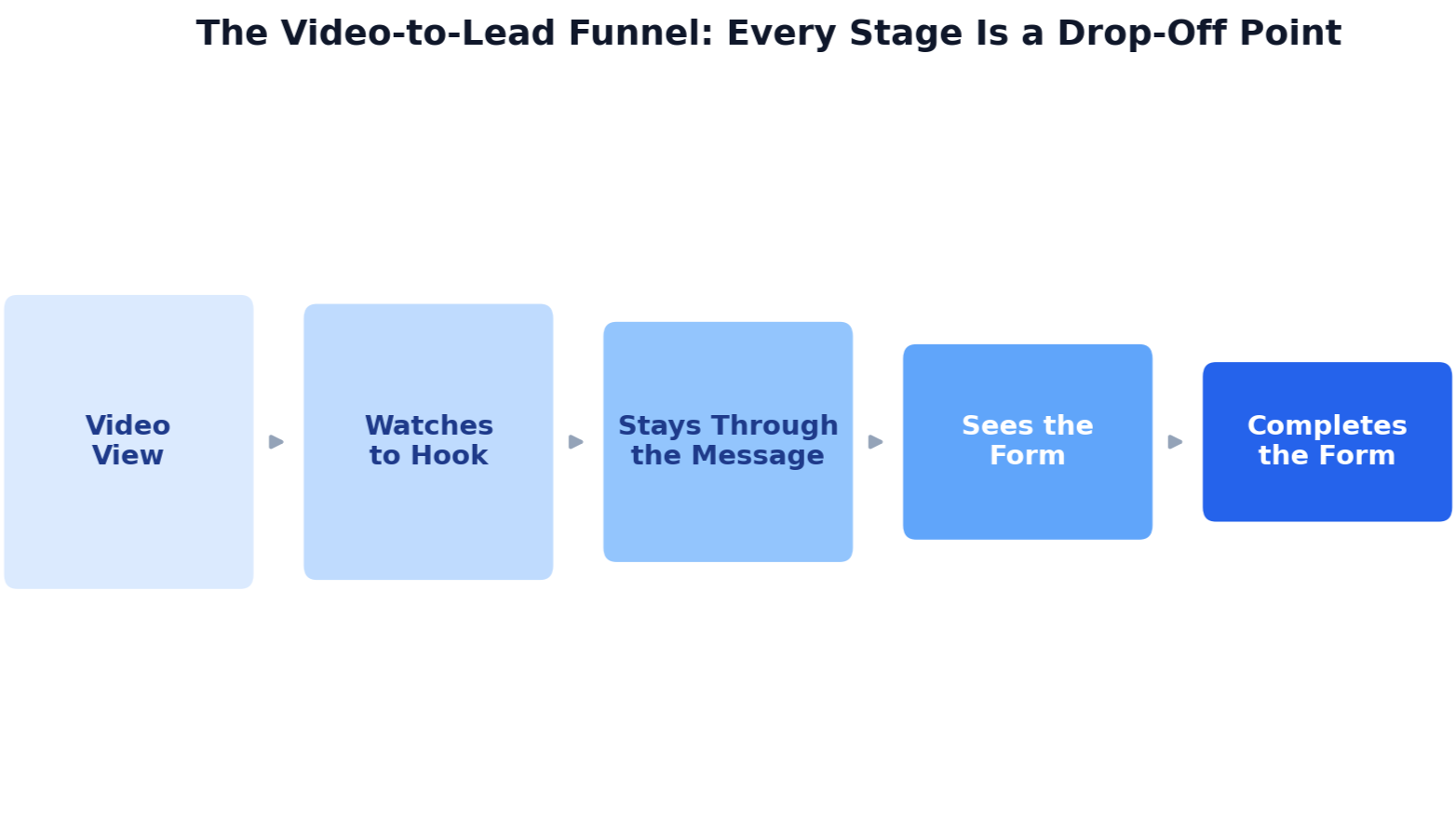
Every one of those five stages is a place people drop off, and most video projects only optimize the first three. The lead capture form sitting at the end of the funnel gets treated as a formality rather than a conversion surface in its own right. Here's where the last two stages usually break, and they break in painfully avoidable ways:
The lead generation form asks for everything at once. Twelve fields on a single screen, right when the viewer's attention is already thinning after 90 seconds of video. Cognitive load spikes exactly when patience is lowest.
There's no segmentation. A viewer who watched the whole thing and one who skipped to the end get the identical set of questions, even though they clearly have different levels of intent.
Partial answers vanish. Someone fills out three of eight fields, gets distracted, and never comes back - and because nothing was saved, that's not a slow lead. That's a lost one.
Nobody tests placement. Teams A/B test video thumbnails and hooks relentlessly. Almost nobody tests where the form itself sits, or how many fields it asks for on the first screen.
What This Looks Like Fixed
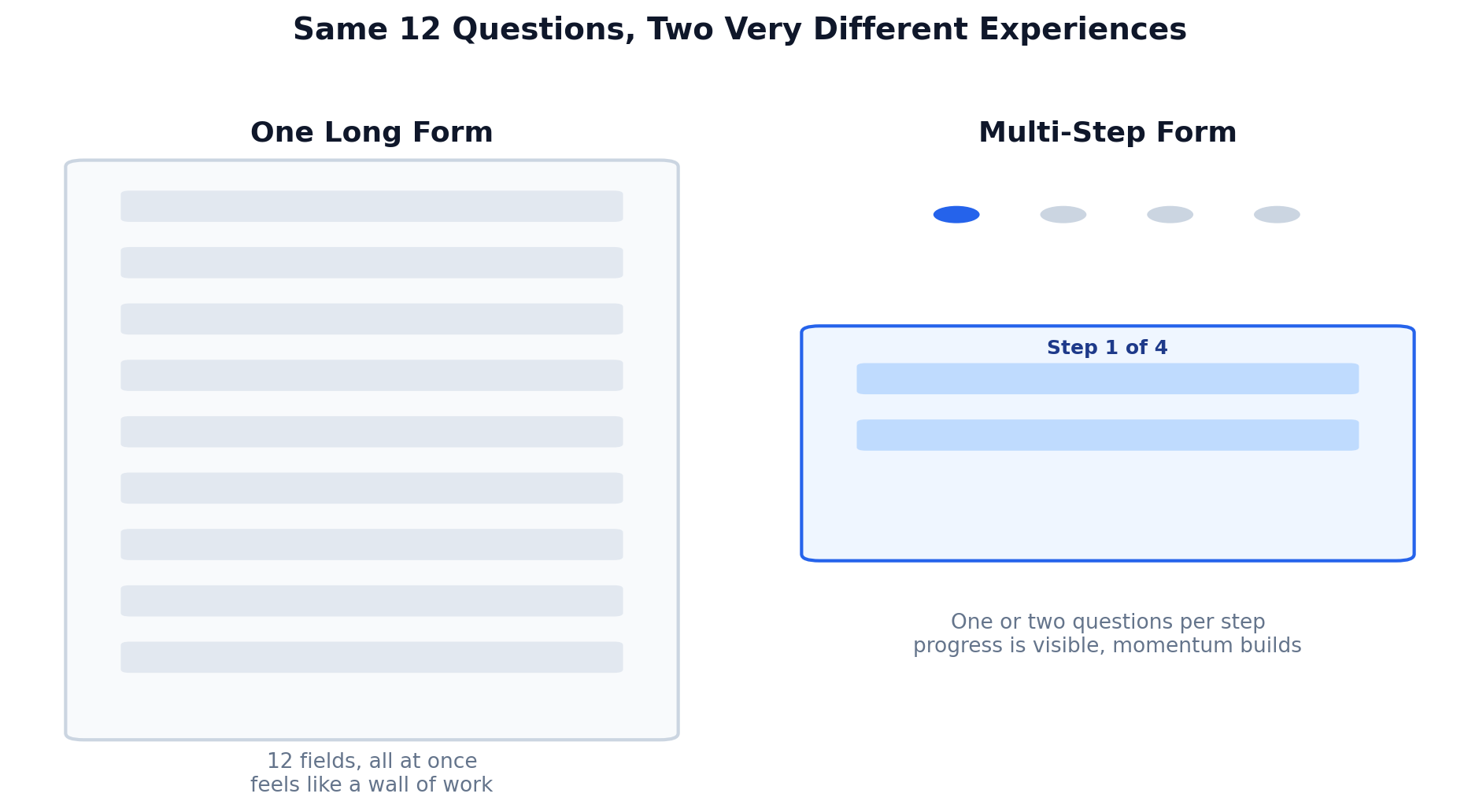
Same twelve questions, two completely different experiences. The form on the left asks a viewer who just spent 90 seconds watching a story to switch instantly into "fill out paperwork" mode. The form on the right is a multi step form: it asks one or two questions at a time, shows visible progress, and lets momentum from the video carry directly into the first step instead of colliding with a wall of fields.
Layer in a couple of small structural changes and the numbers above stop being surprising:
- Move the form, don't just build a better one. The single highest-leverage change is timing: last quarter of the video, not a separate landing page click away.
- Match the ask to the moment. Someone who watched to the end has earned a shorter, higher-intent-signaling form - not the same generic contact form as someone who bounced in five seconds.
- Capture partial submissions. A viewer who starts and stalls is a warm lead you can still follow up with, not a number that disappears from your funnel entirely.
- Test the form the way you test the hook. Field count, step count, and placement all move the needle as much as headline copy does - treat them with the same rigor.
Conclusion
The commercial in this story took ten days and one uncompromising creative decision: don't fake the emotion. But the video was never the whole conversion event - it was the setup. The lead capture form is the close. A team that spends real production effort protecting one facial expression and then ships a twelve-field form with no structure, no segmentation, and no A/B testing has optimized exactly half of the funnel that actually matters.
Video gets a viewer to want something. The form is the only mechanism that turns that want into a name in your CRM. Treat it with the same intentionality, and the 25%-to-58% gap stops being a surprising statistic and starts being a design decision you make on purpose, every time.
FAQs
Q1. What is Video Lead Generation?
Video lead generation is a method by which a business leverages video content to generate qualified leads via viewer activities that include submitting forms, demo requests, and consultations.
Q2. How can video help with lead generation?
Video helps create a connection and emotional engagement on the part of the viewer prior to requesting any kind of action. The timing of lead capture becomes very seamless when the viewer is emotionally engaged.
Q3. At which part of the marketing video should the lead form be placed?
It all depends on the audience and the video being used. In most cases, placing the form towards the end increases the chance that you get viewers who understand the message and have a higher level of interest.
Q4. Why do viewers abandon a lead form while watching a video?
This may be due to the long form or inappropriate placement. Other reasons include irrelevant fields, untimely placements, non-personalized forms, not explaining how their data will be utilized, among others.
Q5. Is multi-step form better than one form in generating leads through video?
It can be used to reduce the perceived complexity of a long form since it breaks down the fields. However, the effectiveness of a multi-form should still be tested against a simple single step form.
Q6. Should marketers embrace AI-generated video for lead generation?
While it is easy to create and come up with ideas using AI, it does not mean that live production should be done away with entirely. It depends on the marketer's needs, timeline, among other factors.
Q7. What should marketers test in a video-to-lead funnel?
Length of the video, timing of the CTA, placement of the lead form, the number of fields, multi or single step form, messaging, and segmenting among others.
About the Author