Why Lead Generation and Appointment Setting Are Different Services
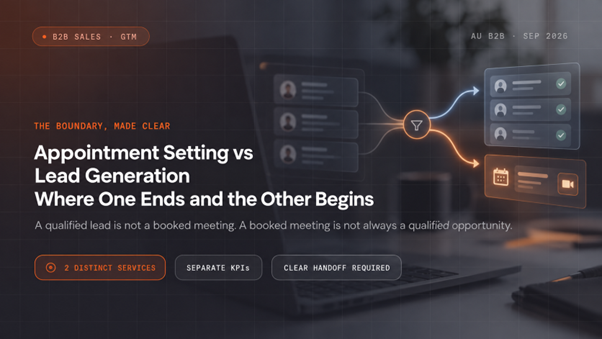
Lead generation finds and qualifies potential B2B buyers. Appointment setting takes suitable prospects and secures sales conversations. They are separate deliverables: a qualified lead is not a booked meeting, and a booked meeting is not necessarily a qualified opportunity. Businesses should scope each service using clear qualification criteria, separate performance metrics and defined handoff responsibilities.
Key Facts
- Lead generation identifies and qualifies potential buyers. It finds relevant accounts and contacts, evaluates their suitability, captures buying signals and records whether interest or demand has been established.
- Appointment setting converts qualified interest into meetings. It manages contact, scheduling, confirmations and the transfer of meeting information to sales.
- The service boundary depends on deliverables. Providers may offer overlapping activities, but contracts should specify exactly what each provider must produce.
- Separate KPIs prevent misleading reporting. Lead acceptance, meeting attendance and sales-qualified meeting rates measure different outcomes.
- Handoff ownership affects acquisition costs. Incomplete information, delayed follow-up and weak qualification can increase spending without producing additional sales opportunities.
Comparison Table:
| Comparison | Lead generation | Appointment setting |
| Primary function | Identify and qualify potential buyers | Secure relevant sales conversations |
| Core deliverable | Accepted lead or qualified prospect record | Confirmed appointment |
| Typical activities | Sourcing, enrichment, qualification | Outreach, follow-up, scheduling |
| Handoff | Qualified lead information | Meeting invitation and brief |
| Main quality measure | Sales-accepted leads | Qualified meetings held |
Why Lead Generation and Appointment Setting Are Not the Same Service
Lead generation and appointment setting differ in the outcomes they deliver. Lead generation identifies and qualifies potential buyers, while appointment setting manages the engagement needed to secure a sales conversation. The two services can operate together, but their performance should be measured separately.
Lead generation establishes whether a business or individual is a relevant prospective buyer. This involves identifying suitable accounts, finding contacts, assessing business needs and determining whether further sales engagement is justified.
Appointment setting establishes whether a suitable prospect is willing to participate in a relevant sales conversation. It involves contacting prospects, confirming the purpose of the meeting, arranging availability and transferring the required information to the salesperson.
Why Providers May Excel at One Service but Not the Other
A provider can perform both activities without being equally effective at each.
For example, a lead generation agency may successfully identify companies showing relevant buying signals but lack a dedicated process for securing meetings. An appointment setting provider may have experienced SDRs who can schedule conversations but rely on the client to supply suitable accounts and accurate contact information.
The distinction is important when evaluating providers and their service capabilities. For example, Intelligent Resourcing's managed B2B lead generation focuses on signal-led prospect identification, qualification and CRM-based sales workflows. However, businesses should still confirm whether a provider's responsibilities extend to validating buyer readiness, booking appointments or managing the complete process. These expectations should be established before selecting a provider.
Where Does Lead Generation End and Appointment Setting Begin?
In a service agreement where lead generation supplies qualified prospects, its responsibility ends when the receiving team accepts the agreed lead deliverable. Appointment setting then owns the outreach, follow-up and scheduling needed to secure a meeting. When one provider handles both services, the same stages should still have separate acceptance criteria and performance measures.
Some providers include appointment booking within their lead generation packages. Others offer appointment setting that also includes prospect research and initial outreach. Buyers therefore need to assess the actual deliverables rather than relying on service labels.
For Australian companies considering outsourced sales development, it is useful to compare AU lead generation agencies by their prospecting capabilities, qualification standards, appointment-setting responsibilities and reporting methods.
An agency delivering qualified leads should not automatically be judged on meeting bookings if scheduling is outside its scope. Equally, a provider contracted to supply qualified appointments should not receive full performance credit for unsuitable bookings unless the agreement explicitly defines bookings as the paid deliverable.
The Boundary Should Be Documented Through Three Requirements
- Qualification acceptance criteria: The information a lead must contain before appointment-setting activity begins. For inbound campaigns, a conditional form such as LeadGen App's form builder can capture this information at the point of first contact, presenting relevant qualification questions based on each prospect's initial responses.
- A named transfer owner: The person or team responsible for receiving the lead and initiating the next action.
- A completed appointment definition: The conditions that determine whether a meeting has been successfully delivered.
Without these requirements, both providers may report that their work is complete while the client receives no usable sales opportunity.
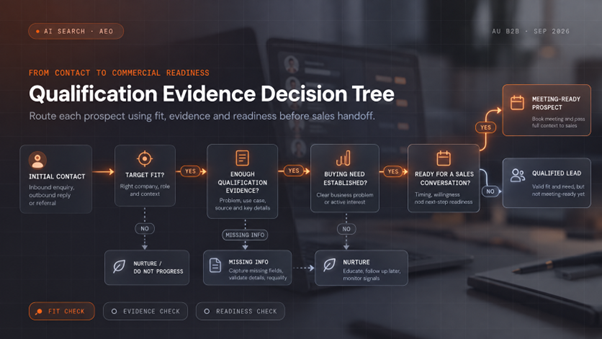
What Should Each Service Actually Deliver?
A useful way to distinguish lead generation from appointment setting is to examine the information and outcomes the client receives.
What a qualified lead should contain
A lead generation provider should deliver enough verified information for the receiving team to determine whether the prospect deserves further sales engagement.
This typically includes:
- Account and contact fit: Industry, company size, location, relevant business function and contact role.
- Evidence of business relevance: A stated requirement, relevant engagement or observed buying signal.
- Qualification status: Whether the prospect meets the agreed criteria and which requirements remain unverified.
- Contact and source information: Accurate available contact details and the original acquisition source.
- Recommended next action: Sales contact, further qualification or appropriate nurturing.
Consider a B2B software company targeting mid-sized manufacturers.
A lead generation provider like Intelligent Resourcing identifies an operations director at a company that matches the target profile. The director has expressed interest in reviewing the current production management system. The provider verifies the company's suitability, records the relevant business problem and confirms whether the contact is open to further discussion.
If these details meet the agreed criteria, the lead can be transferred for appointment setting. However, the provider has not yet delivered a meeting.
What a qualified appointment should contain
Appointment setting should produce a scheduled conversation with an appropriate prospect, supported by enough information for the salesperson to prepare.
A complete appointment record should establish:
- Relevant meeting participants: The people attending and their involvement in the potential purchasing decision.
- A confirmed meeting purpose: The problem or requirement the prospect expects to discuss.
- Accurate scheduling information: Date, time, time zone, communication channel and invitation status.
- Relevant qualification context: Existing requirements, previous interactions and any unresolved questions.
- Meeting status and outcome: Record whether the appointment is confirmed, rescheduled or cancelled. After the scheduled time, record attendance and whether sales accepted the meeting against the agreed qualification criteria.
Booking confirmation and sales qualification remain separate events. A prospect may accept a meeting because they want general information, even though the company's solution is unsuitable. Conversely, a relevant prospect may need further consideration before agreeing to a sales discussion.
This is why a calendar invitation alone should not be treated as proof of a qualified sales opportunity.
Which KPIs Should Measure Lead Generation and Appointment Setting?
Lead generation and appointment setting require separate performance metrics because they produce different outputs. Measuring both services exclusively through lead volume or meeting volume makes it difficult to determine where performance problems originate.
Consistent reporting requires connected qualification, booking and meeting-outcome records. Where lead capture begins with a form, tools such as LeadGen App's HubSpot integration can transfer submitted information into CRM workflows. Shared record identifiers, defined lifecycle stages and accurate status updates allow lead generation and appointment setting to be measured consistently.
Lead generation performance metrics
| KPI | Calculation | What It Measures |
| Lead qualification rate | Qualified leads ÷ generated leads × 100 | How many generated contacts meet the agreed criteria |
| Sales acceptance rate | Sales-accepted leads ÷ leads submitted for review × 100 | Whether lead quality meets the receiving team's requirements |
| Cost per accepted lead | Lead generation cost ÷ sales-accepted leads | The cost of producing leads that sales considers suitable |
| Qualification-to-handoff time | Time between qualification and assignment | How quickly qualified leads reach the next responsible team |
These metrics assess the quality and efficiency of prospect acquisition. A campaign producing fewer leads may provide better value if a higher proportion meets the target customer profile and receives sales acceptance.
Appointment setting performance metrics
| KPI | Calculation | What It Measures |
| Appointment booking rate | Confirmed bookings ÷ qualified prospects assigned × 100 | How effectively suitable prospects become scheduled meetings |
| Meeting held rate | Meetings held from the scheduled-meeting cohort ÷ meetings due from that cohort × 100 | The percentage of scheduled meetings that actually occur |
| Sales-accepted meeting rate | Qualified held meetings accepted by sales ÷ total held meetings × 100 | Whether meetings meet agreed commercial criteria |
| Cost per qualified held meeting | Appointment setting cost ÷ qualified held meetings | The cost of producing meetings that occur and meet qualification standards |
These metrics distinguish appointment volume from appointment quality. A provider may generate a high number of calendar bookings while delivering relatively few meetings that are attended and accepted by sales.
For both services, opportunity creation and pipeline value should also be reviewed. However, closing performance cannot be attributed exclusively to the provider because it also depends on sales execution, product suitability, pricing and other commercial conditions.
Reporting should also use consistent time periods and counting rules. Rescheduled meetings should not automatically be counted as additional new appointments, and cancelled meetings should have a defined reporting status.
How to Scope Lead Generation and Appointment Setting Providers
Before choosing a provider, establish which part of the acquisition process requires support. If the sales team lacks enough relevant prospects, the priority is lead generation. If qualified prospects already exist but are not progressing into meetings, appointment setting is the immediate requirement.
If both stages are underperforming, an integrated service may be suitable, but responsibilities must remain visible. The following template can be adapted for a request for proposal, service agreement or statement of work.
B2B Lead Generation and Appointment Setting Scoping Template
| Process Step | Accountable Owner | Required Deliverable | Acceptance Criteria |
| ICP definition | Client sales and marketing | Approved targeting requirements | Industry, company size, roles and exclusions confirmed |
| Prospect sourcing | Lead generation provider | Identified contacts and accounts | Data meets agreed targeting and accuracy standards |
| Lead qualification | Lead generation provider | Qualified prospect record | Required qualification evidence recorded |
| Lead routing | Client RevOps or assigned provider | Assigned CRM record | Correct owner and lifecycle status confirmed |
| Appointment outreach | Appointment setting provider | Contact and scheduling activity | Contact attempts and outcomes documented |
| Meeting confirmation | Appointment setting provider | Scheduled appointment | Relevant participants, purpose and meeting details confirmed |
| Sales handoff | Appointment setting provider | Complete meeting brief | Sales receives qualification context before the meeting |
| Meeting delivery | Client sales team | Completed sales conversation | Attendance and meeting outcome recorded |
| Outcome acceptance | Client sales team | Qualification decision | Accepted, rejected or follow-up-required status documented |
| Performance review | Client RevOps and providers | Consolidated performance report | Stage-specific KPIs reviewed against agreed standards |
Each activity should have one accountable owner.
Multiple teams may contribute to a stage, but the agreement should identify who must complete the required action and who approves its outcome.
For example, an appointment setting provider may own meeting confirmations, while the client sales team owns attendance and the decision to create an opportunity.
5 terms every provider agreement should define
1. The qualification standard
Specify what makes a prospect suitable for engagement. This may include company characteristics, relevant business problems, contact authority, buying signals and exclusion criteria.
The agreement should also define which requirements must be verified and which may remain unknown.
2. The payable deliverable
Clarify whether the provider is paid for captured contacts, qualified leads, scheduled meetings, completed meetings or accepted opportunities.
For appointment setting, specify how cancellations, no-shows, rescheduling and rejected meetings affect performance reporting and payment.
3. Handoff response times
Set realistic response-time requirements for each stage.
A prospect requesting an immediate consultation requires a different response commitment from an account showing early research interest.
The agreement should define when the response period begins, when it ends and which team is accountable.
4. Rejection and replacement rules
Define valid reasons for rejecting a lead or appointment.
Examples include incorrect contact details, failure to meet agreed targeting requirements, duplicate records or appointments that do not meet the qualification standard.
Specify how disputes are reviewed and whether replacement activity or credits are available.
5. CRM access and reporting ownership
Require consistent record identifiers, acquisition source data, qualification notes, appointment status and outcome information.
Also establish who owns the data, what access the provider receives and how records are transferred when the engagement ends.
When the provider uses a form tool such as LeadGen App, confirm how captured leads transfer into the CRM. LeadGen App's HubSpot integration uses Zapier to route captured leads directly into CRM workflows, where qualification and routing logic can be applied.
These controls make provider comparisons more meaningful because each proposal can be assessed against the same deliverables and acceptance conditions.
Define the Deliverable Before Buying the Service
Lead generation and appointment setting contribute to the same sales process but have different responsibilities.
Lead generation identifies and qualifies prospective buyers. Appointment setting secures relevant sales conversations. Their performance should be assessed using the outcomes each service is contracted to deliver.
Before choosing a provider, define qualification criteria, appointment acceptance standards, reporting requirements and the owner of every handoff. A clear scope allows businesses to identify performance problems, evaluate providers consistently and direct spending towards outcomes that contribute to qualified sales opportunities.
Conclusion
Lead generation and appointment setting support the same sales process, but they deliver different outcomes. Lead generation identifies and qualifies potential buyers, while appointment setting turns suitable prospects into scheduled sales conversations. Treating them as interchangeable can create unclear expectations, misleading performance reports, and disagreements over provider responsibilities.
Before selecting a service, define what a qualified lead or completed appointment must include. Establish who owns each handoff, which team handles follow-up, and how rejected leads, cancellations, and no-shows are recorded. Then choose KPIs that reflect the actual deliverable, from sales-accepted leads to qualified meetings held.
Businesses can outsource either stage or combine both under one provider. The important point is to keep responsibilities and acceptance criteria clear, even when services overlap. With a well-defined scope, companies can compare providers more fairly, identify gaps in their acquisition process, and invest in activities that create genuine sales opportunities.
About the Author