5 Top Software Development Outsourcing Companies in Eastern Europe for 2026
Picking the right engineering partner overseas is tougher than it sounds. Rates matter, but so does a team's actual ability to ship on schedule, in the right stack, without needing constant supervision.

Eastern Europe has emerged as one of the most active regions for software outsourcing because it combines technical depth, European time zones, and genuine project ownership in a way that's hard to find elsewhere. The five companies below represent some of the strongest software development outsourcing options in Eastern Europe and are worth a close look before you sign anything.
Eastern Europe's software development market in 2026
The region's reputation isn't accidental. Countries like Poland, Estonia, and Ukraine have been producing strong engineering talent for decades, and that pipeline is still growing.
Poland alone graduated over 100,000 IT specialists in 2024, according to the Polish Agency for Enterprise Development, and the country has maintained its position as one of the top nearshore destinations for Western European and US companies alike.
What's changed recently is the maturity of the service layer sitting on top of that talent. More Eastern European firms now handle end-to-end delivery - from discovery through post-launch support - rather than simply providing bodies to fill seats.
US companies can now outsource at the project level, not just the headcount level, and that fundamentally shifts the conversation. Costs remain favorable. Mid-senior developer rates in Poland and Estonia typically run between $45 and $85 per hour, compared to $120 to $200-plus for equivalent roles in Western Europe or the US.
And because most Eastern European hubs share business hours with the UK and Central Europe, the overlap is workable even for US teams operating early mornings.
1. Netcorp Software Development Company
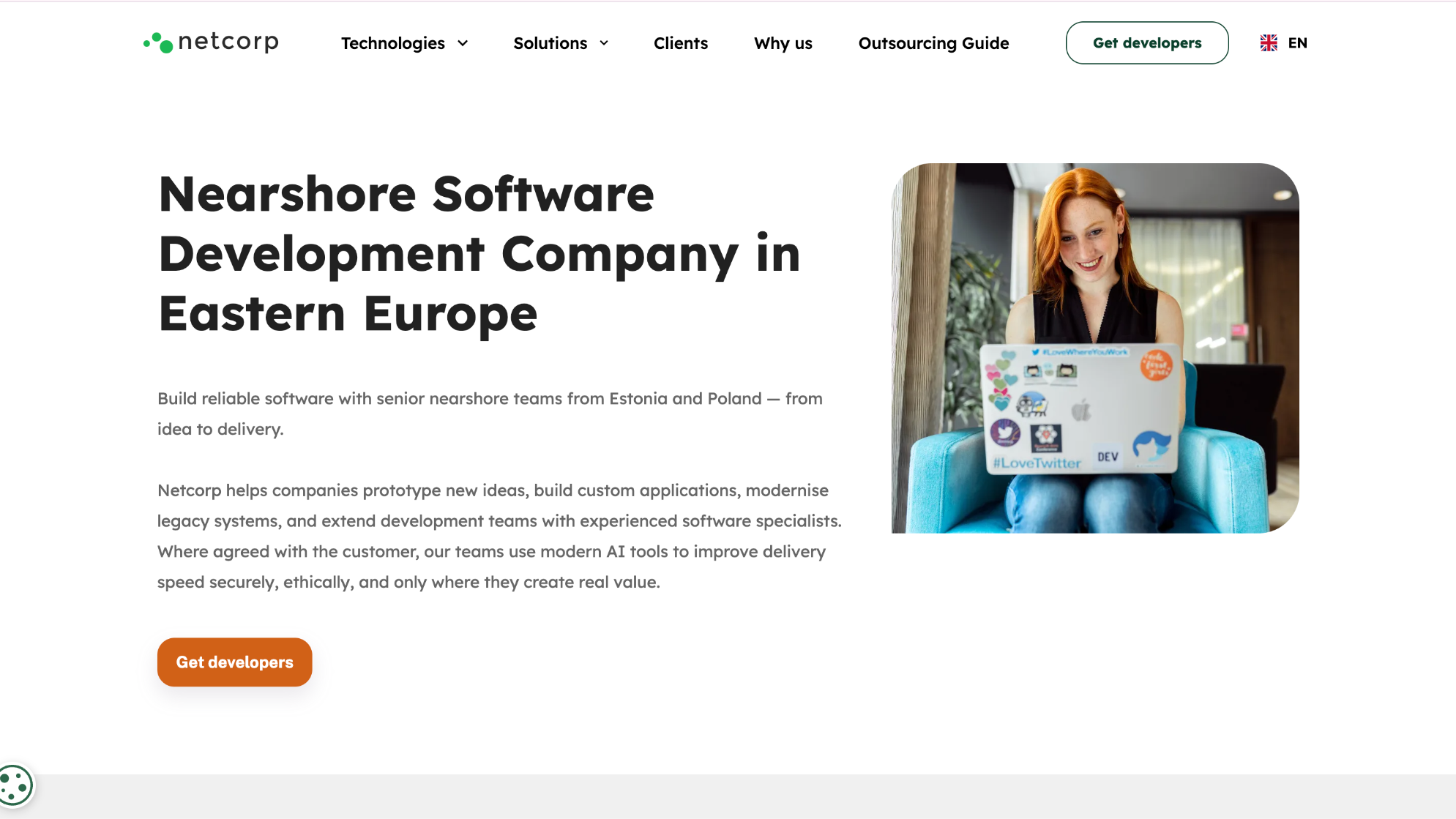
What it does: Netcorp is a nearshore software development firm headquartered in Estonia with over 15 years of experience delivering dedicated engineering teams and full software projects. Their talent pool draws from Poland and Estonia, and their client base runs heavily toward Scandinavia, the UK, and the US.
Fintech, telecom, SaaS, healthcare, and logistics represent some of their strongest industry verticals. They operate primarily through two engagement types: team extension (dedicated developers embedded long-term) and full software project delivery from concept to launch. A free 30-minute outsourcing consultation is available for companies still figuring out scope.
Where it shines: The firm covers a broad technical range - Java, .NET, Python, Flutter, React Native, AWS, Azure, Snowflake, Databricks, Dynamics 365, and more.
That depth makes them particularly useful for companies that need more than a front-end team: clients like Telia, Monese, and Ygrene have worked with Netcorp on complex, multi-stack builds. With 250-plus in-house developers and a reported 4.9 out of 5 rating on Clutch, the team is large enough to staff up quickly - the firm cites a one- to eight-week ramp time to project kickstart.
2. Shore Teams
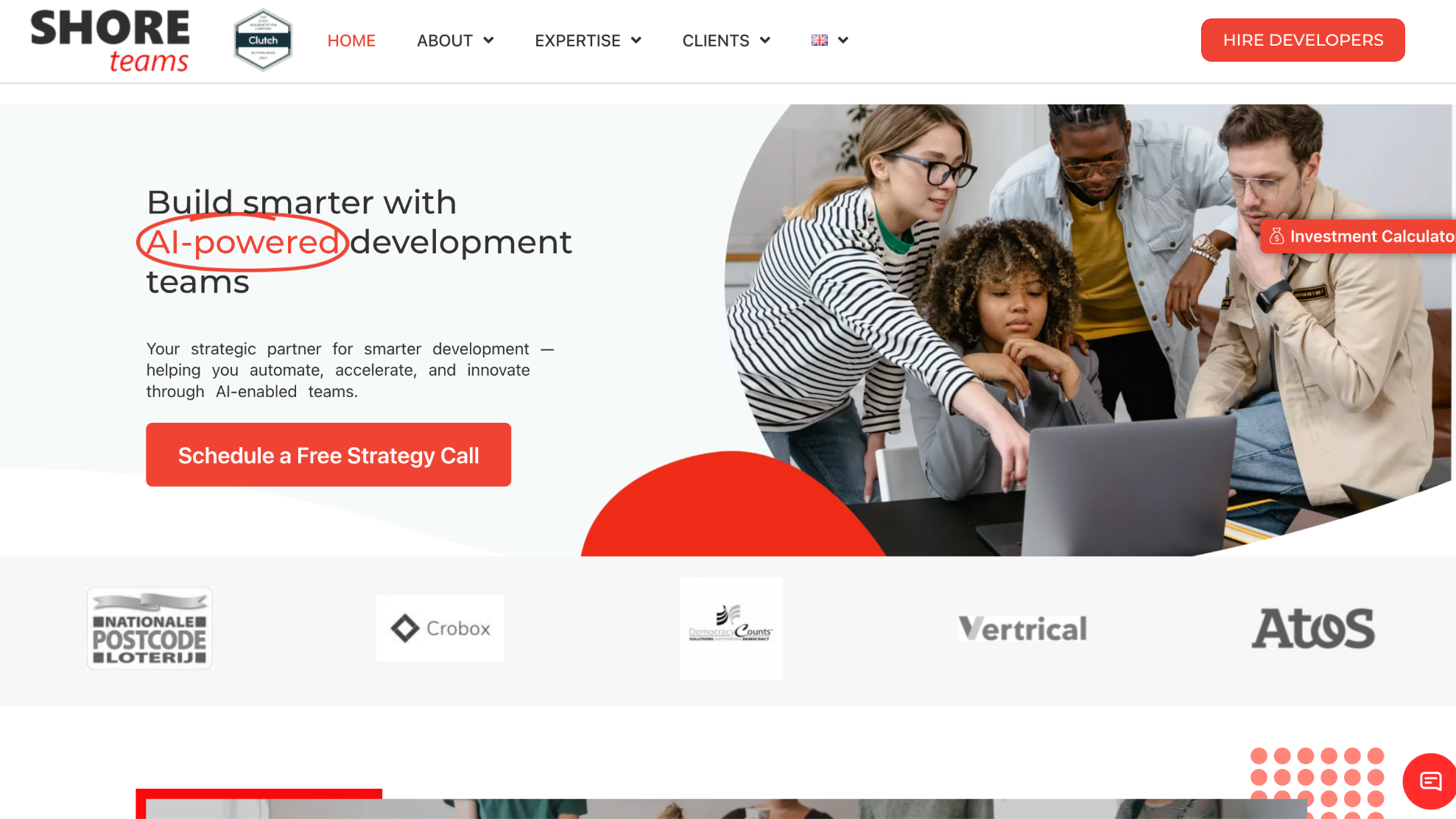
What it does: Shore Teams is an Amsterdam-based intermediary founded in 2017 by Eelke Broersma and Sander Dales. Their model focuses on connecting businesses with nearshore and offshore development teams, working through a network of over 500 development partners and access to more than 30,000 developers globally.
They cover software, web, and mobile development across nearly any technology stack.
Where it shines: Shore Teams is built for companies that want to move fast on team assembly without vetting dozens of vendors individually. Because their service to clients is funded by the partner network rather than direct fees, there's no placement cost on the client side, a meaningful advantage for companies testing a new outsourcing model before committing.
Their stated focus is on the outstaffing model and long-term team relationships rather than short project bursts. The intermediary model works well when a client's requirements are clear and well-scoped; companies that need a tightly integrated delivery partner rather than a talent broker may find a more hands-on agency a better fit for complex builds.
3. Lean Code
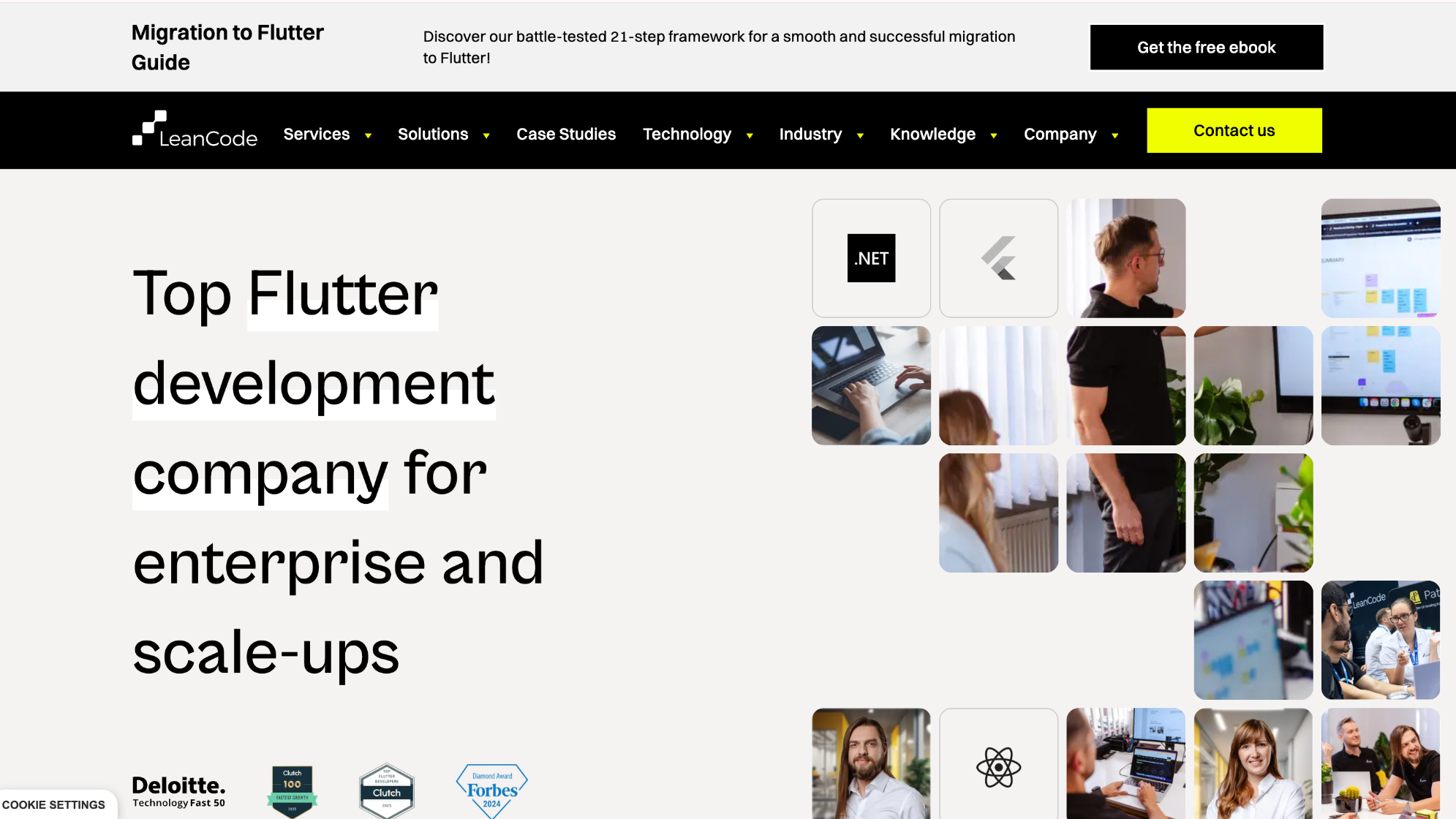
What it does: Lean Code is a Warsaw-based full-cycle software development company founded in 2016 by Łukasz Kosman and Jakub Wojtczak. The team has grown to over 80 engineers, designers, and product strategists. They're best known for mobile development, Flutter in particular, and hold official Flutter consultant status from Google, which is a meaningful credential given how few firms have it.
Where it shines: For product companies building cross-platform mobile apps, Lean Code offers a level of Flutter depth that's hard to find. The team includes over 30 Flutter developers and two Google Developer Experts. They also created Patrol, an open-source Flutter UI testing framework that's become a reference tool in the community.
Past clients include Virgin Money, Tide, Shell, and Millennium Bank, a portfolio that spans fintech, banking, and enterprise. Their service model moves through discovery, delivery, and growth phases, including AI work and long-term support. Their specialization in Flutter is a strength for mobile-forward companies but a narrower fit for teams with heavy backend or enterprise platform needs.
4. Itelence

What it does: Itelence is a Warsaw-headquartered IT outsourcing and business process outsourcing firm. Their service stack covers IT staff augmentation, nearshoring, managed services, extended project teams, data engineering, SAP and Salesforce consultancy, cloud infrastructure, RPA, and e-commerce development. On the BPO side, they offer finance and accounting, master data management, and business analytics.
Where it shines: Itelence positions itself as a low-friction entry point for international companies, particularly those from Western Europe and the US, looking to hire into the Polish market. The Build-Operate-Transfer model lets a company start with a small team and eventually fold it into their own operation.
That makes them a practical option for companies that aren't sure whether they want a vendor relationship or an owned offshore capability. Their delivery model and emphasis on starting with a single FTE reduces early-stage commitment risk. The breadth of services, from SAP to e-commerce to BPO, suggests a generalist profile, and companies with specialized technical needs may want to confirm depth before committing.
5. UKAD
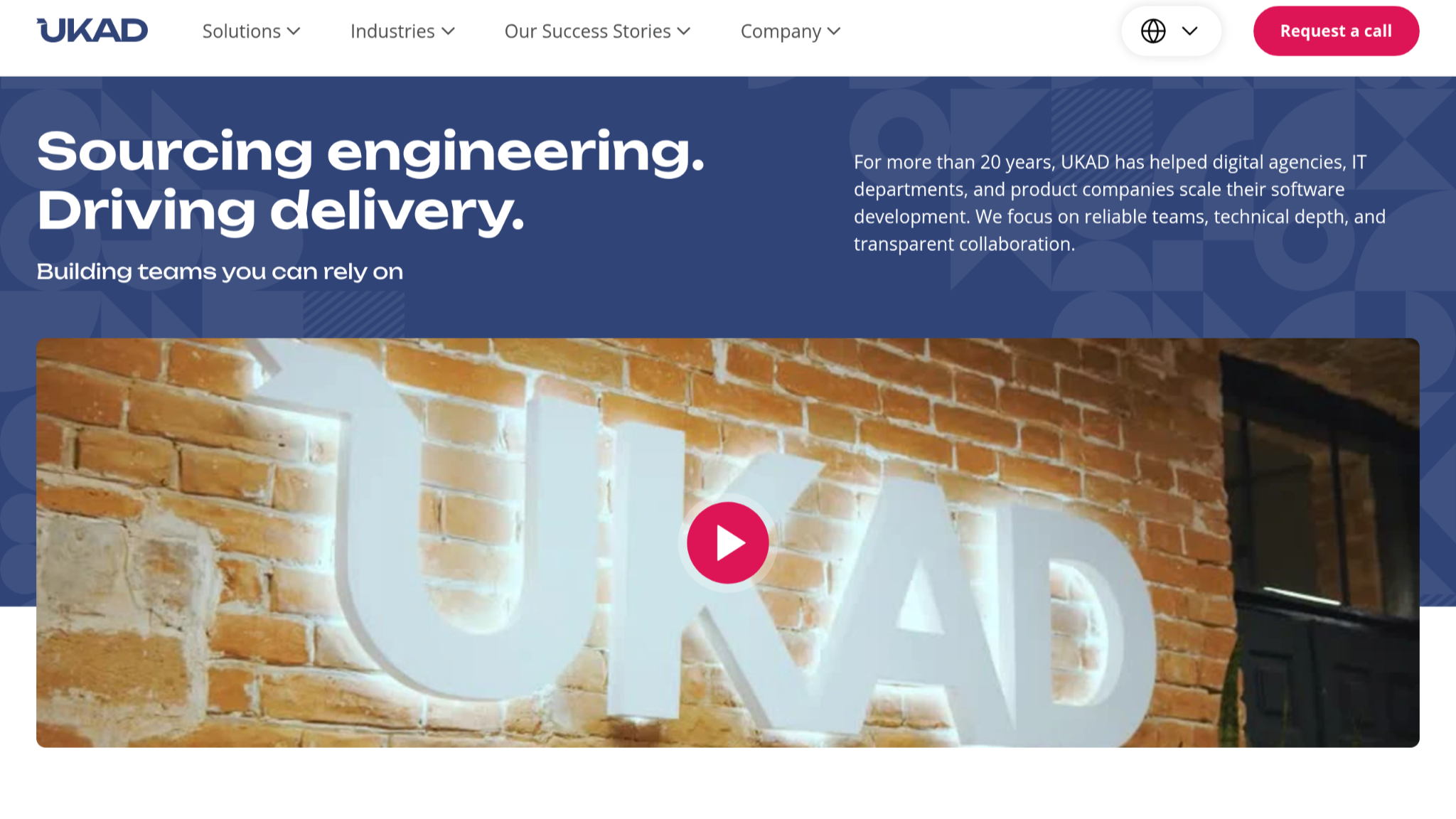
What it does: UKAD is a nearshore software engineering company founded in 2005, operating with over 300 engineers across Poland and Ukraine. They work through staff augmentation, dedicated team, and full outsourcing models.
Technology focus includes .NET, Node.js, React, Vue.js, Angular, Azure, AWS, GCP, React Native, .NET MAUI, Umbraco, and Optimizely, with certified Microsoft developers and DevOps engineers on staff.
Where it shines: UKAD's numbers on retention are strong: 95% client retention, 50-plus long-term partners, and a reported five-plus year average developer tenure. That kind of stability matters when a project runs 18 months or more.
Their case studies include a 10-plus year collaboration with AJ Produkter across 19 countries using Optimizely and React, and work with a digital agency involving AI solutions and R&D. Industries covered span fintech, healthcare, logistics, eLearning, and travel.
With 90% of new projects coming from client recommendations, UKAD isn't heavily marketed, and companies expecting a polished sales process may find the firm more operationally focused than sales-forward.
What to evaluate when picking an outsourcing partner
A few criteria separate good choices from expensive mistakes.
Engagement model fit. Staff augmentation works when a company already has a strong internal lead and needs skilled hands. Full project delivery works when the company lacks the internal capacity to manage day-to-day engineering. Intermediary brokers work when speed of placement matters more than a single integrated team. Knowing which model the problem actually calls for narrows the list quickly.
Technical depth vs. breadth. Some firms specialize narrowly (Flutter, SAP, Optimizely); others cover a wide stack. Neither is inherently better, but a mismatch is costly. Ask for case studies within the specific technology the project requires, not just general references.
Retention and tenure. Developer turnover mid-project is one of the biggest hidden costs in outsourcing. A firm's average developer tenure and client retention rate are better predictors of execution consistency than any proposal document.
Time zone and communication. Eastern European teams typically offer strong overlap with UK and Western European hours. For US teams on the East Coast, a five to seven hour offset is manageable with structured daily standups; West Coast teams should ask explicitly about async communication practices.
Ramp time. For urgent builds, the difference between a firm that can start in two weeks versus eight matters. Some firms maintain a bench of available developers; others staff from scratch for each engagement.
Bottom Line
The strongest software development outsourcing companies in Eastern Europe differ more in model and specialization than in raw talent quality; the engineering pool across Poland, Estonia, and neighboring countries is solid at every price point.
The real decision comes down to what a company actually needs: a broker who moves fast, a specialist team with deep niche knowledge, or a full-cycle partner who can own delivery from kickoff through maintenance. Matching the engagement model to project reality is what matters most.
About the Author