How to Build B2B Lead Capture Forms That Protect Data and Improve Qualification
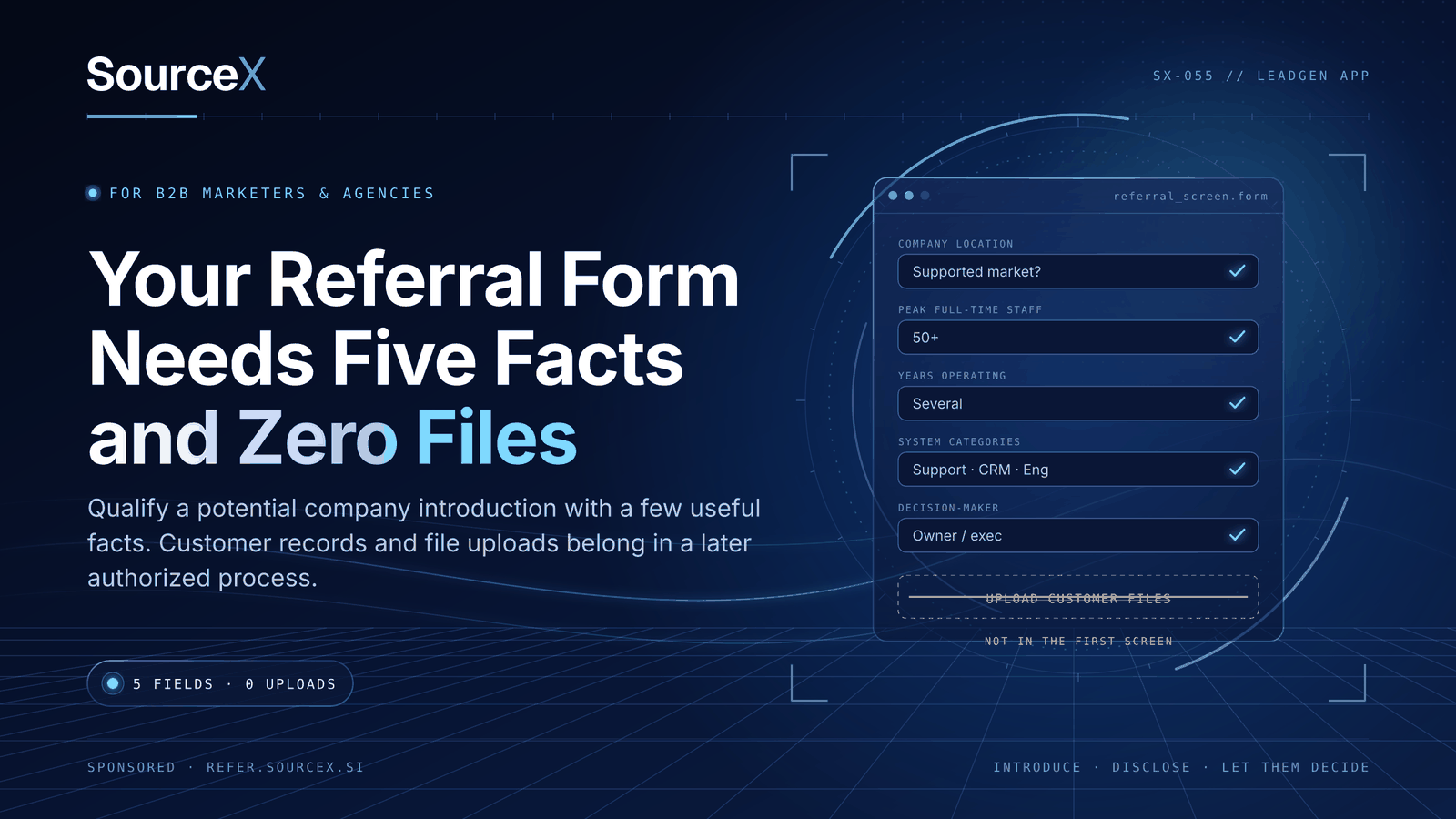
Every marketer understands the temptation. Add one more field and lead scoring will be improved, and an upload box will assist the sales team to prepare for the next call.
When it comes to AI data licensing referrals, all of those things work against you. The sole mission of B2B referral lead qualification in this case is to establish the fact of existence of a legitimate company and authorized contact person. Any customer records and confidential messages should never appear on the first screen.
The idea here is to learn whether this company is willing to have an assessment done. It is not to create the dataset by using marketing forms.
Five questions that will change the next step
Before making an introduction, you must first establish your approved partner account and sign the SourceX Channel Partner Agreement. Make sure there are no employment/client/professional commitments that might prevent you from receiving your referral payment, let the company know about your reward, and ask for its permission.
If an answer would not change the screening decision, consider removing the field. A useful first pass covers these five questions:
1. Where is the company based, and what language is most of its data in?
2. What was its approximate peak full-time headcount?
3. How many years has it operated?
4. Which systems hold its work history: support, CRM, engineering, documentation?
5. Who is the authorized decision-maker, and have they agreed to an introduction?
Tell people why you are asking. Microcopy such as “These facts help confirm broad fit. They don’t guarantee an offer or a payment” sets expectations before they become a problem.
Remove open upload fields and prompts for customer examples. A business leader can describe a support or CRM history without disclosing its contents. Ask for enough information to route the introduction, and explain why any additional fields are necessary.
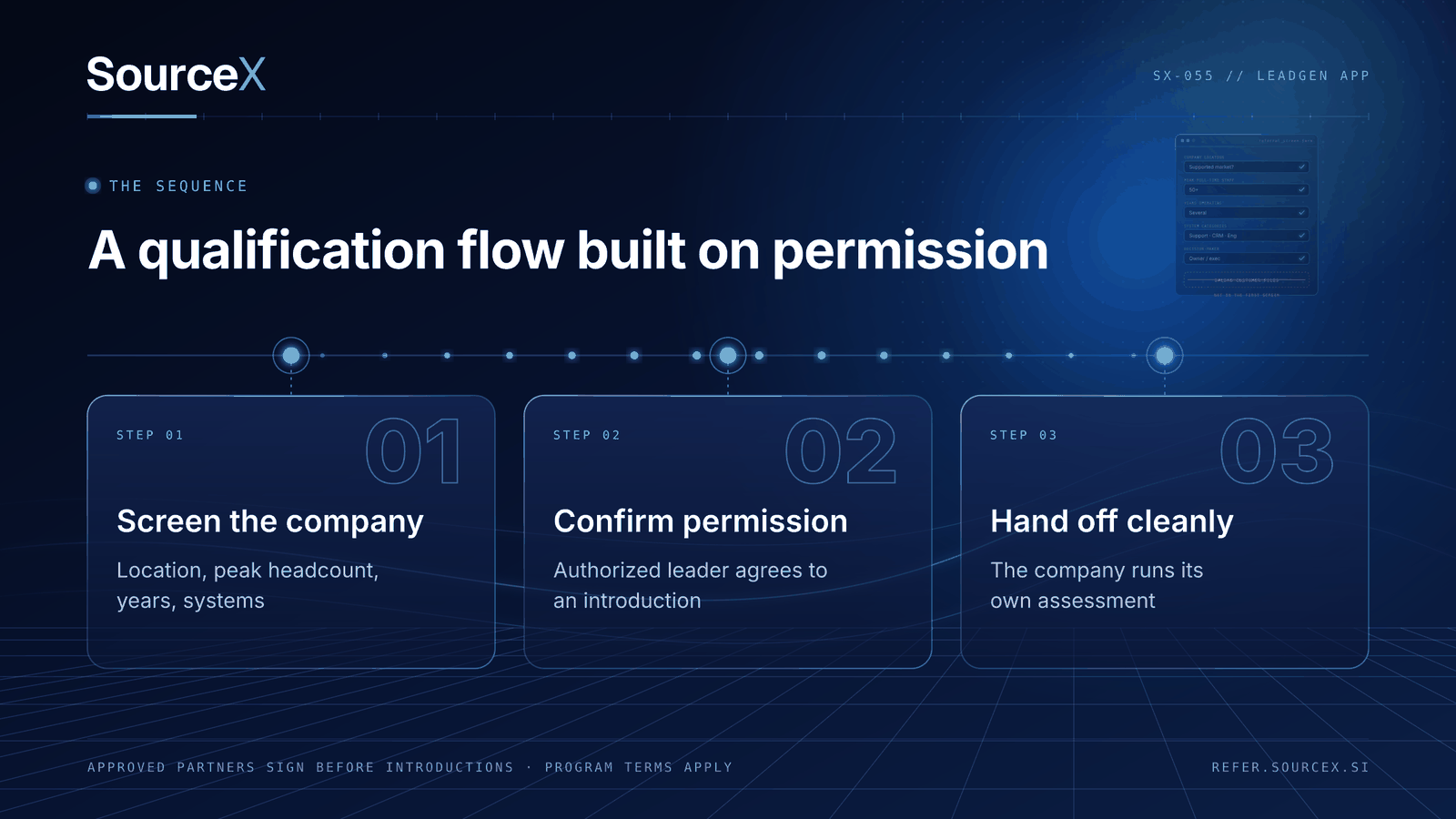
A qualification flow built on permission. A conceptual sequence drawn from this article, not a measured result or a completed transaction.
Permission belongs next to the email field
The existence of the public email cannot be used as proof of consent. Neither can it prove that the company has agreed to go through licensing evaluation nor that the company has agreed to become a part of the nurturing cycle.
Place a permission question by the side of the contact field and make sure that the reason for the referral is clear. When you need to do anything else other than what you stated initially, then use the right method.
Plain wording works best. Something like “I confirm the person named above has agreed to be introduced to discuss an AI data licensing assessment” is unambiguous, easy to audit and impossible to mistake for a newsletter opt-in. If the referrer cannot tick it honestly, the lead is not ready.
The referrer should also disclose any potential compensation before asking the company to act. That disclosure is part of the qualification journey, not small print after it. Referrers with employment, board or professional duties should check those rules before accepting any fee.
A public email address is not consent.
Which reward terms belong beside the submit button?
The SourceX referral program publishes its terms, and the honest move is to surface them inside the form itself. An info panel beside the submit button might read:
a. Reward: 25% of Actual Supplier Payout, excluding separately itemized taxes and expense reimbursements, capped at $100,000 cumulatively per referred company unless signed terms say otherwise.
b. Paid separately by SourceX, so the company’s agreed payout is not reduced.
c. Payment remains conditional on final buyer acceptance and handoff, cleared buyer funds at SourceX, supplier payment, finance approval, required tax and payment details, and lawful payment.
d. No reward is earned by a submitted lead, a booked meeting or a signed agreement on its own.
e. Hypothetical arithmetic only: a $120,000 qualifying supplier payout would produce a $30,000 reward. Not a forecast or a reported deal.
Actual Supplier Payout is the compensation actually paid for selected data that reaches Closing and the qualifying completed handoff. It excludes separately itemized taxes and expense reimbursements, the partner reward, SourceX's fees and the buyer's full transaction price. Unpaid estimates do not count; rewards accrue as supplier installments are paid.
The $100,000 cap applies cumulatively to each referred company across installments, agreements, repeat licenses and renewals; it never resets. SourceX pays the reward separately, without reducing the supplier's agreed compensation.
The signed Channel Partner Agreement's Schedule A and agreed addenda control the rate, calculation base and cap.
The reward deadline is 60 calendar days after the later of the buyer's final written, unconditional acceptance and completed handoff of the complete, validated and approved dataset. Paying also involves the availability of cleared funds from the buyer at SourceX, supplier payment, financial clearance, partner required payment and taxation information, and legal payment. Should any outstanding condition exist at the time of deadline, paying is done immediately after it is fulfilled without the start of another 60 days' period. The payment schedule for suppliers is independent.
Make sure your path is in line with these requirements. In sending out a thank-you note, the next action needs to be described and not profit gained. When a calculation example is provided, its underlying assumptions and conditions need to be stated along with its outcome.
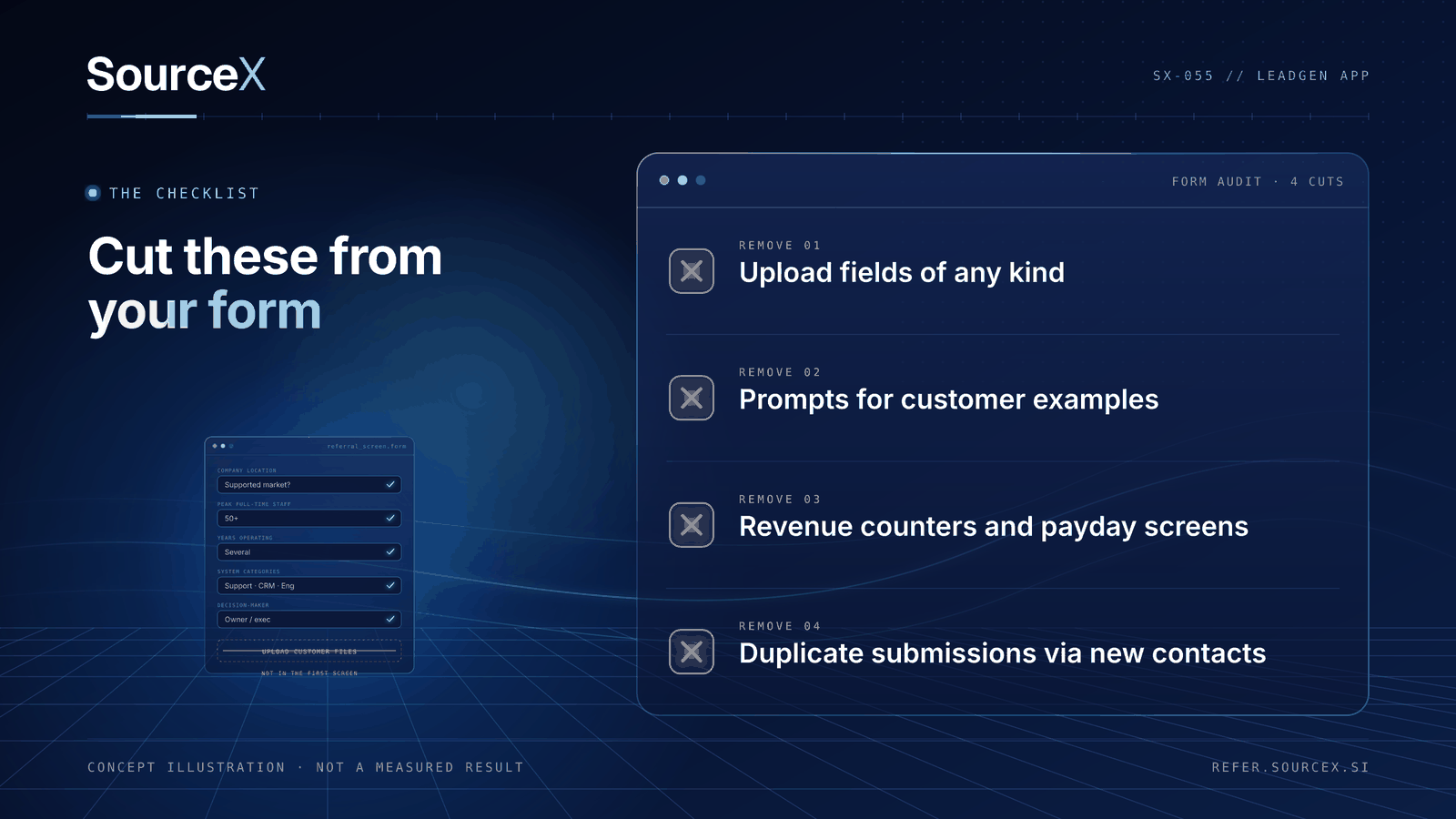
Cut these from your form: the four checks this article walks through.
How do company fit and referral attribution differ?
Fit is about the company. SourceX’s stated core profile includes at least 50 full-time employees at peak and several years of operating history, with supported location, language, rights and dataset suitability also in play.
Fit and attribution are separate. Credit goes to the first valid introduction of a new company when it submits a verified application within the 90-day attribution window. SourceX checks dated introduction evidence, existing applications and prior relationships; an earlier click alone does not secure credit. Earlier leads, accounts or email correspondence can make a company a duplicate. Only one partner is credited per company.
Deduplicate by company before submitting. Several contacts at one business are not several reward opportunities, and a positive fit screen does not establish referral credit.
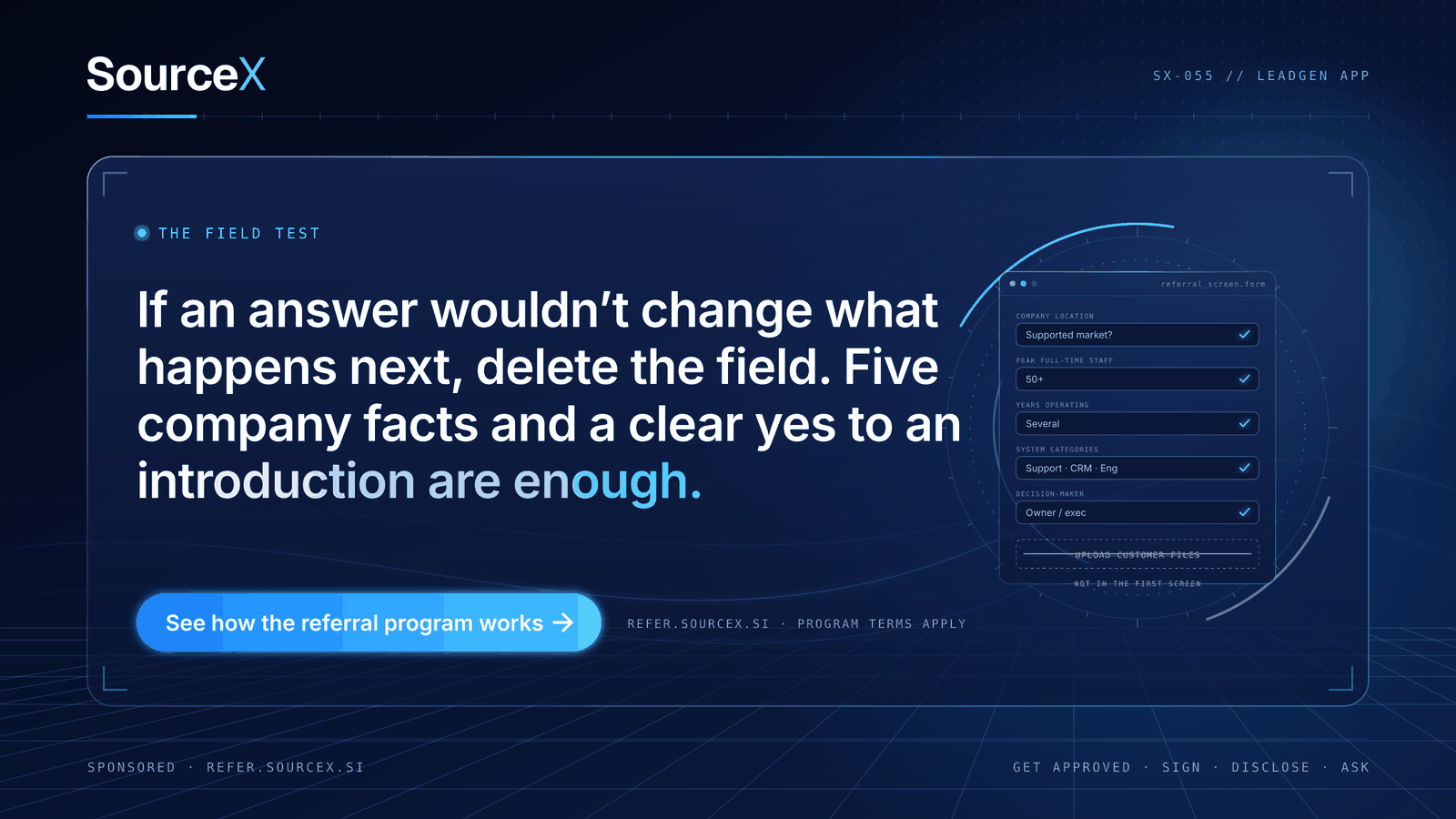
The field test: If an answer wouldn’t change what happens next, delete the field. Five company facts and a clear yes to an introduction are enough.
What should happen after a positive screen?
Connect the authorized leader and let the company decide whether to continue. From there the assessment belongs to the company and SourceX, including qualification, rights, scope, preparation and terms. In your CRM, log it as a qualified introduction with the permission timestamp, then stop adding fields.
Any later request for records should come through an authorized review, never through an ever-expanding marketing form.
Measure B2B referral lead qualification differently, too. The best conversion in this funnel is not the most data captured. It is an informed company decision with a clear contact, and not a single customer file attached.
Review the SourceX referral program before turning a positive screen into an introduction. Use an approved partner account and sign the agreement first. Record permission, disclose the possible fee and keep company records off the form.
Conclusion
The successful lead qualification for the B2B referral process begins with the rule that only necessary data should be collected about your potential business partner to determine their fit and create a legitimate introduction. Five facts about the company, confirmation of authorization and referral agreement will give you the opportunity to get an initial screening without disclosing customer files and confidential business information.
Check the eligibility of the company, find the duplicates, and inform the person about rewards. If a field will not change the next step, remove it. If additional records are needed later, they should be requested through an authorized assessment process - not an expanding marketing form.
Before submitting a referral to SourceX, confirm that the partner account and agreement are in place, disclose any potential compensation, and record the contact’s permission. The goal is not to collect more data. It is to create a legitimate, informed introduction that the company can choose to pursue.
About the Author