Affiliate Marketing ROI: How to Measure, Improve, and Scale Results

Affiliate marketing has become one of the most profitable acquisition channels for brands, with businesses in the US spending over $12 billion on affiliates in 2025. But the line between profitability and loss is razor-thin.
Poor tracking, non-tiered incentives, or a lack of set process can turn a high-potential program into a money pit. And you may see affiliates falling away by the droves with no idea what pushed them away.
The good news is that performance doesn’t have to depend on luck. With a repeatable process, you can keep track of what’s working (and what isn’t) and work toward a positive return on investment (ROI) over time.
Let’s go over how you can measure, improve, and scale your affiliate marketing ROI.
What Is Affiliate Marketing ROI (and Why It’s Your Most Important Metric)?
Affiliate marketing ROI is the profit you generate from your affiliate efforts compared to the total cost of running them. It is the easiest way to see whether your affiliate program is truly profitable.
The formula is simple:
ROI = (Net Profit – Total Cost) x 100
Here’s what that means:
- Net profit = Total commission earned – Total costs
- Total cost is every expense tied to your affiliate program, like commissions to paid partners, platform or network fees, creative production, and management time
A program that earns $100,000 in sales might look successful at first glance. But if you’ve spent $90,000 on payouts, tools, and management, your ROI is just 11%.
This is why ROI matters more than revenue. The revenue tells you only how much you sold, not how much you spent to get those numbers.
How to Measure Your Affiliate Marketing ROI

You need the right data to know if your business is generating a profit or just movement. Here’s how to get it:
1. Track Every Dollar You Earn
While your affiliate platform will show gross commissions, you need to know what it actually costs to generate those earnings. This means you need to:
- Segment your revenue into one-time sales and recurring commissions to understand which sources contribute most to long-term ROI
- Make sure your tracking links and cookies are configured correctly to capture every sale and prevent leaked or misattributed commissions
- Account for network payment terms like Net-30 or Net-60 to make sure your revenue is recorded in the right period
2. Account for All of Your Costs
ROI is about net profit, not just revenue. This means to calculate it properly, you need to know all the costs tied to your affiliate program, including:
| Direct Costs | Operational Costs | Hidden Costs |
| Affiliate commissions and bonuses | Management salaries or agency fees | Time spent on partner communication |
| Performance incentives and contests | Software costs (analytics tools, CRM, email marketing) | Legal and compliance costs |
| Platform fees (monthly + percentage fees) | Content creation, like blog posts, banners, and video production | Payment Processing Fees |
| Website hosting and development for affiliate portals | Training and onboarding materials |
3. Segment Your Performance Data
Not all affiliates or campaigns provide equal value. To find out where you earned the most profit from, you need to group your data. Here’s how:
- Affiliate partner. This helps you see who drives real conversions instead of traffic with low ROI.
- Campaign type. This includes seasonal, evergreen, influencer, content publisher, and more.
- Product/offer. You should take note of all the items that bring the highest returns after costs.
Segmentation helps you identify what’s working and what’s dragging your ROI down. It also shows where you need to double down and make changes or cut back.
4. Measure Over Consistent Time Frames
You have most of the information you need to make a judgment of your affiliate marketing campaign’s profitability at this point. But you might still not see the full picture if you’re looking at data only from one month.
Track your ROI monthly, quarterly, or campaign-by-campaign to see real trends and see the impact of changes like commission adjustments or new partner onboarding as they happen.
If you’re unsure where your affiliate costs or partner data are slipping through the cracks, talk it through with our affiliate marketing agency. We’ve set up high-ROI affiliate marketing programs and can help you find where your biggest gains are hiding.
5. Plug into the Formula
Once you have accurate numbers for both earnings and costs, you can plug those numbers into the ROI formula to understand your profitability.
You can also use an affiliate tracking platform like Rewardful or an integrated analytics tool to automate this calculation. It’ll pull in data on commissions, partner payouts, and campaign expenses, which means you’ll be looking at real-time metrics.
6 Ways to Improve Your Affiliate Marketing ROI
If your ROI results didn’t come out looking so good, here are six ways you can improve your affiliate marketing ROI:
1. Choose the Right Partners and Products

Not all affiliates are equal. The ones who move the needle share your audience’s interests, pain points, and language. This means you need to build a roster of partners who already influence your ideal customers, including:
- Micro-influencers
- Niche experts
- Complementary software vendors (for SaaS)
While you can go with big-name influencers as well, you’ll only get reach without much results since their audiences are huge, distracted, and expensive to convert.
2. Provide Your Partners with High-Converting Assets
Affiliate success depends on what you put in your partners’ hands. Instead of a single tracking link and hoping for the best, give them a brand bank with ready-to-use email templates, social captions, banner ads, video demos, case studies, and product data sheets.
This benefits you in three ways:
1. Your partners share a story that fits your brand values and messages, which means brand consistency.
2. Affiliates will also be more likely to promote your products when the heavy lifting is done for them, which means increased partner output.
3. You create repeatable processes and assets that drive long-term profitability.
3. Perform a Data-Driven Performance Analysis
If you want to increase your affiliate marketing profitability, you need to understand which partners actually drive profit. Here are some metrics that can help you see how each partner fits into your customer journey:
- Customer lifetime value (LTV)
- New vs. Returning customers
- Multi-touch attribution
When you dig into this data, you may start to see patterns.
For instance, if a partner has fewer sales but converts a lot of customers who renew or upsell more often, this would make them more profitable in the long run.
You can use this data to:
- Allocate higher commissions or bonuses to partners who bring high-LTV customers
- Reduce spend on partners who drive short-term or low-value traffic
- Double down on partner roles and provide the right brand assets to the right partners, like top-of-the-funnel content for awareness-focused affiliates
Data tells you not just who sells but who sells smart. Acting on that distinction is how you grow your ROI over time.
4. Set up Retargeting Campaigns

When your affiliates send a visitor to your site, you’re getting a warm lead that’s already pre-sold to some degree. But since the average conversion rate for e-commerce is only 2–3%, this means 97–98% of your high-value traffic will leave without buying. Without retargeting, that 97% will be gone forever.
But if you launch a retargeting campaign, you can show ads to those specific visitors for the next 30–60 days to remind them of your product. When one of those retargeted visitors finally buys, you get the highest possible return from the money you’ve spent.
5. A/B Test Everything for Gains that Add Up
In affiliate marketing, small tweaks often mean big returns. Instead of scrapping an affiliate program campaign entirely if it isn’t working, experiment with commission rates, landing page layouts, ad copy, and partner creatives to find what actually moves the needle.
Start slow and test one thing at a time, like a shorter landing page headline or a higher bonus threshold for partners. Even if you see a 2% increase in leads, it could mean double the profit without extra ad spend.
6. Implement a Tiered Commission Structure
Most brands start with a flat payout for every sale. While this seems simple, it rarely rewards the partners who bring in the most value. This may mean lost sales, lower output, and low ROI over time.
To avoid that, you can set up a tiered commission structure that matches payout levels with performance and customer quality. You could offer higher rates to affiliates who bring in high-LTV or subscription customers, hit a consistent monthly sales target, or drive sales without heavy discounting.
You can also experiment with blended models, like giving a small upfront bonus for leads plus a recurring percentage on renewals.
When to Scale Your Affiliate Marketing Program ROI
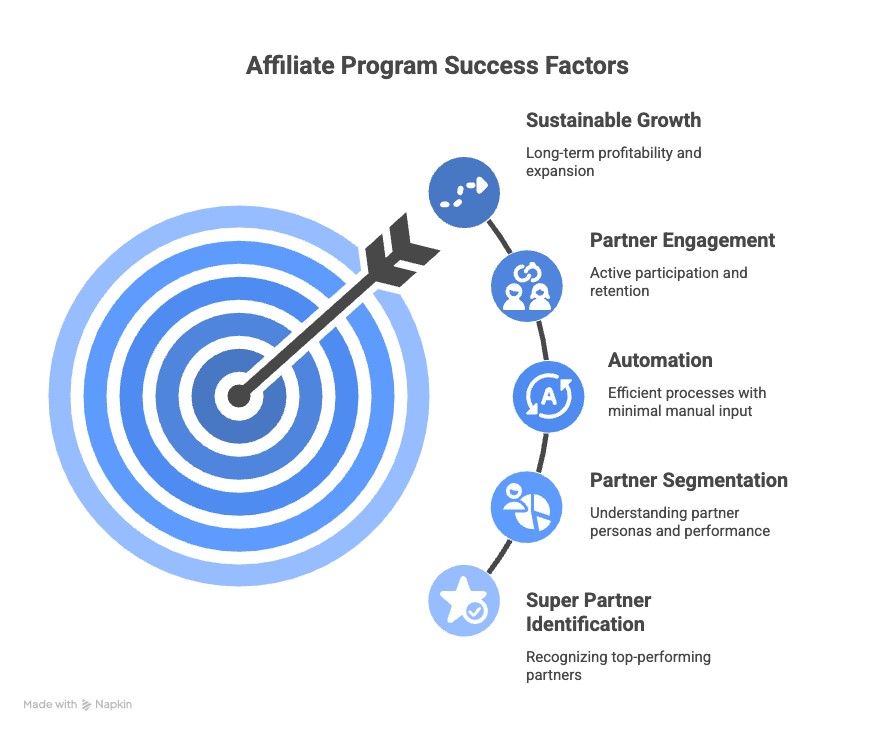
Here are six signs your affiliate program is ready for more investment and could see higher ROI:
- You already have a positive ROI. Your affiliate program should have a full quarter of data showing your program is profitable. You should be able to see positive returns from top-of-funnel partners all the way to bottom-of-funnel partners.
- You’ve identified your “super partners.” You need to know which 20% of partners drive 80% of results. You should be aware of who they are, what content they use, and why they convert, so you can replicate that success.
- You’ve automated what you could. Your onboarding, tracking, and payout processes run without breaking down or needing much manual input.
- You’ve mapped your partner personas and performance tiers. You have clear segments for partners and know the exact LTV and ROI each persona delivers.
- Your partner churn is low, and engagement is high. Your partners are staying and working with you over long periods. Your asset downloads and communication response rates are high, which means a healthy affiliate program.
- You have a documented playbook for recruitment and management. Your processes for finding, vetting, onboarding, and activating new partners are documented and repeatable. To scale those systems efficiently, many growing teams are turning to AI Recruiting software to automate candidate sourcing, streamline screening, and standardize evaluation criteria. By embedding AI-driven workflows into your documented recruitment framework, you ensure faster hiring cycles, data-backed decision-making, and consistent partner quality without increasing manual workload.
Building Sustainable ROI in Affiliate Marketing
Affiliate marketing can be one of the highest-ROI growth channels when managed with precision and patience. It’s not just about recruiting more affiliates, but also about recruiting better ones, tracking the right metrics, and constantly refining how you measure performance.
When you treat ROI as an ongoing process instead of a one-time calculation, you start to see where the real profit drivers are hiding. The partners who align with your audience, the assets that convert repeatedly, and the campaigns that quietly outperform the rest: all of these insights compound over time.
The key is consistency: measure accurately, analyze honestly, and invest strategically in what works. Do that, and your affiliate program will evolve from a cost center into a predictable, scalable revenue engine.
About the Author