The Hidden "Lead Gen Tax": Why Software Budgets are Spiraling in 2026
Lead generation is the lifeblood of any scaling business, but in 2026, the cost of growth has reached an all-time high. Many marketing teams are no longer just paying for data but they are unknowingly paying a "Hidden Lead Gen Tax."
This tax is the result of choosing bloated platforms that sell unnecessary complexity under the guise of "enterprise-grade" features. When a tool becomes pipeline-critical, buyers often stop shopping with logic and start "panic-buying" features they don't actually need.
Consequently, lead generation software pricing has shifted from affordable monthly utilities to massive annual liabilities.
The Difference Between "Value-Based Pricing" and "Revenue-Trap Pricing"
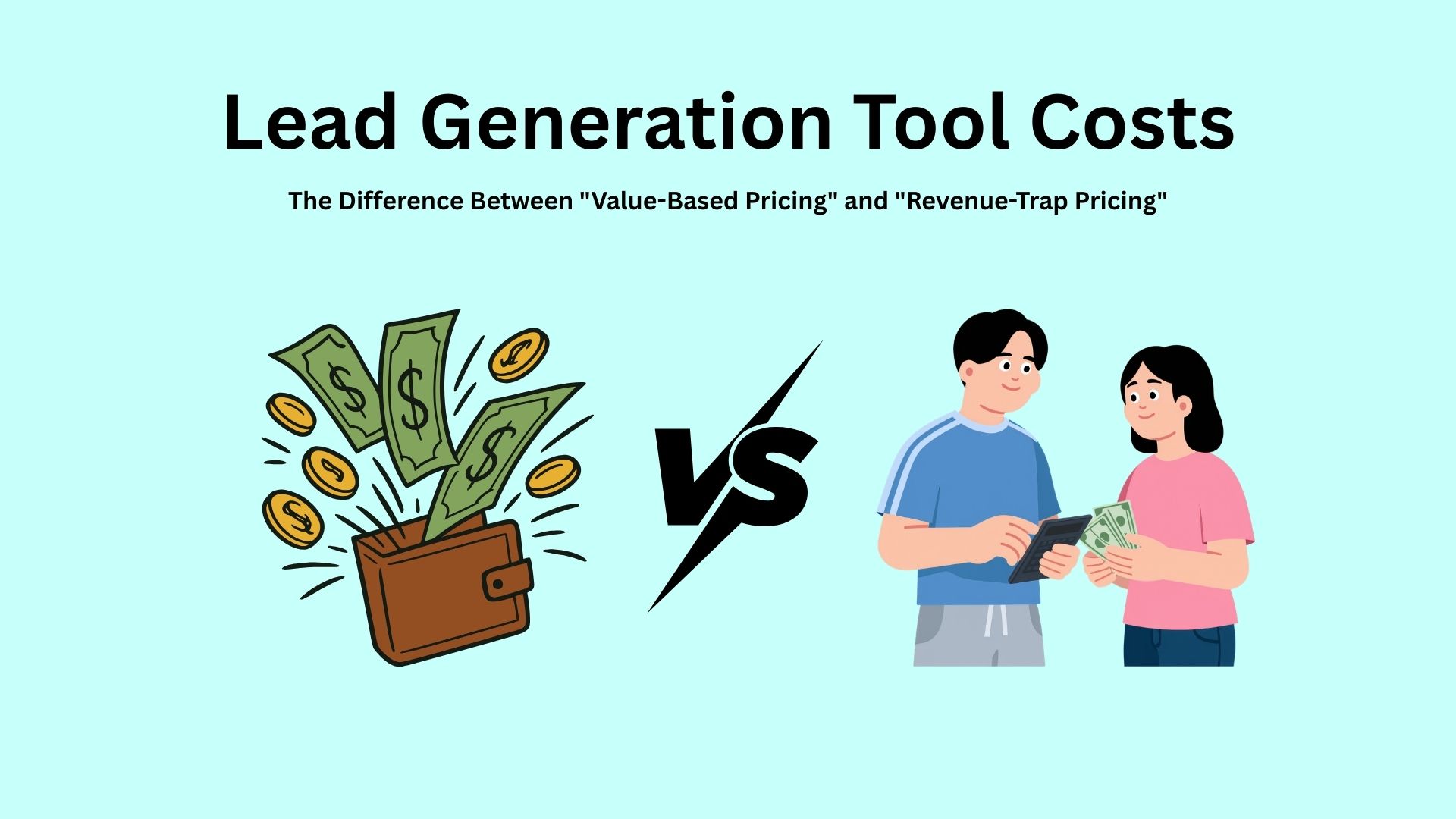
Software vendors understand that lead generation is directly tied to your company’s revenue.
This knowledge allows them to employ "Revenue-Trap Pricing" strategies that target the buyer's emotions rather than their operational needs. The pattern is predictable: you start with a demo of a "starter tier" that feels safe and affordable.
However, you soon realize that the base plan is essentially a brochure. To generate real results, you are forced into a cycle of upgrades, extra seats, and expensive integrations that can balloon your original budget by 3x to 10x within just six months.
Audit Before You Buy: Why Most Teams Settle for Bloated Tech Stacks
In an era of endless SaaS options, the most valuable skill for a growth leader isn't just picking a tool but it’s avoiding a pricing model that scales like a nightmare.
Many organizations settle for giant enterprise database platforms costing upwards of $40k a year, even when their team only requires targeted extraction or basic lead enrichment. This mismatch between utility and cost is exactly where the "340% overpay" originates.
Before committing to a stack that resembles a "spaghetti bowl" of costs, a rigorous audit of your actual needs versus the vendor's promised features is essential.
Even something as simple as an instagram email scraper used to be cheap and straightforward. Now it’s often wrapped into bloated platforms with enterprise-level pricing for no good reason.
Lead generation software pricing went from “eh, 30 bucks a month” to “sure, that’ll be 22k per year, and also you can’t cancel unless you fax us during a lunar eclipse” weirdly fast.
And yeah, part of it is the market growing. Part of it is platforms doing more things.
But honestly? A big chunk is just pricing strategy. Vendors figured out that lead gen touches revenue, so buyers get emotional about it. When something is “pipeline-critical,” people stop shopping carefully and start panic-buying features.
That’s exactly why even simple tools like an email scraper are now often bundled into overpriced all-in-one platforms instead of being offered as standalone affordable utilities.
Here’s the pattern I see over and over:
Step 1: You demo a tool. You see a starter price. You feel safe.
Step 2: You realize the starter tier is basically a brochure. To use it for real, you need upgrades, seats, credits, integrations, or all of the above.
Step 3: Six months later, the stack looks like a spaghetti bowl, finance is mad, sales says they “need it,” and you’re paying 3x to 10x what you originally thought.
This financial "spaghetti bowl" often stems from a lack of high-level capital management. For businesses struggling to untangle these spiraling costs, exploring a debt consolidation loan can be a strategic way to streamline existing liabilities, freeing up the necessary budget to reinvest in leaner, more efficient lead generation tools.
If you’re shopping for lead generation tools for 2026 right now, the main skill isn’t “pick the best tool.” It’s “don’t get boxed into a pricing model that scales like a nightmare.”
The sneaky pricing mechanics (where the money actually goes)
Most people think lead gen tools have one price. Nope. They usually have like 4 or 5 prices layered on top of each other, and you only discover them once you’re already halfway committed.
Per-seat pricing sounds fair until you do the multiplication
Per-seat is the classic: “Only $49/user!” Cool. So for 1 (one) person it’s fine. For a real team, it explodes.
Example: $49 per seat with a 10 person team.
$49 x 10 = $490/month, or $5,880/year.
And that’s before add-ons, before overages, before you realize only 6 (six) of those people actually log in weekly. You basically start paying a “team tax.”
Contact-based pricing is the quietest budget killer
CRMs and email platforms love contact-based pricing because it punishes you for… growing. Or for being messy with your data. Or for importing lists with old leads you meant to clean “someday.”
This is where you think you have 5,000 leads, but the tool says you have 11,000 “contacts” because:
- duplicates
- bounced emails from 2019
- unsubscribed folks you’ll never email again
- random junk from forms and exports
So you pay for garbage data. Fun.
Ironically, even if you’re using something as simple as an email scraper, you can still end up paying for all that inflated contact data once it enters your CRM.
Usage-based pricing: death by “credits”
Credits are where budgets go to die quietly. The base plan looks fine, then someone starts:
1) verifying emails in bulk
2) enriching leads
3) exporting data weekly
4) running automations that call the API constantly
And suddenly you’re paying more in credits than the subscription. Also, nobody can explain why the bill went up, they just shrug and say, “uh, we’re using it more.”
Annual commitments and auto-renew: the lock-in trap
Vendors love annual billing because it makes churn harder. You might hate the product by month 4, but you’re stuck until month 12. And some vendors require cancellation notice windows that are basically designed to make you miss them.
This is a huge reason companies overpay. They pay not because the tool is worth it, but because getting out is painful.
Implementation costs are real money, even if you don’t pay a vendor
This part drives me nuts because it doesn’t show up on pricing pages.
Time costs money. And lead gen tools often take real time to:
1) set up domains and mailboxes
2) configure routing and pipelines
3) connect CRM, calendars, Slack, whatever
4) build lists and workflows
5) train the team
Even “easy” tools can eat 15 to 40 hours if you do it properly. If your team’s fully loaded hourly cost is, say, $50 to $100, you can accidentally burn a few thousand bucks just getting the thing online.
The “340% overpay” thing explained with real math

“Overpaying by 340%” sounds like clickbait until you realize how people actually buy lead generation software.
Most orgs anchor to the cheapest visible number, then slowly add the stuff they need to function. So the final number is not 1.5x bigger. It’s often 3x to 5x bigger.
A realistic example: the starter plan that turns into a monster
Let’s say a company thinks they’re buying “$50/month” marketing automation. Then reality hits:
- Subscription: $50/month
- Extra seats: now it’s $150/month
- CRM cleanup and migration: 15 hours internal
- Integrations: 10 hours internal
- Training: 8 hours internal
If internal time is $75/hour, that’s 33 hours x $75 = $2,475 in labor.
So month one cost is basically: $150 + $2,475 = $2,625.
And people still talk about it like it’s a “$50/month tool” because that’s what procurement saw first. This is the psychology bit. Humans anchor. Vendors know it.
The more extreme case: enterprise database when you needed a list builder
This is where the real “wtf” overpayments happen.
If you pay 15k to 40k a year for a giant enterprise data platform, but your team mostly needs:
1) targeted scraping or extraction from social platforms
2) exported leads for outbound
3) basic enrichment
…then the gap isn’t 2x. It can be 10x to 25x.
And that’s where “340%” as a median starts to feel plausible. Not everyone is wasting 2,000%. But enough people are wasting huge amounts that the middle number ends up ugly.
Conclusion: Reclaiming Your Lead Gen ROI
The "340% overpay" isn't just a statistic; it’s a wake-up call for businesses to audit their lead generation tool costs. As we’ve exposed, the trap usually begins with a simple "starter plan" that quickly spirals into a "spaghetti bowl" of seats, credits, and hidden implementation fees.
To maximize your ROI in 2026, you must stop paying the "team tax" and avoid being locked into bloated enterprise platforms when a standalone, high-utility tool is all you truly need.
By simplifying your tech stack and focusing on clean, actionable data, you can strip away the overhead and focus on what really matters is generating revenue.
Don't let your software budget scale like a nightmare - pivot to efficiency today.
About the Author