Why Your Landing Page Copy Isn't Converting Leads
Today's marketing stack revolves around generating leads through sheer volume driven by speed due to the quick adoption of generative AI. It allows growth marketers to create cold email campaigns, ad copy, and multiple landing pages much quicker than before. However, a disturbing trend has emerged among performance dashboards: traffic and impressions look good, but form completions have been falling like a stone.
The problem does not lie in your targeting and offer itself. Most often, it is the copy.
The Synthetic Trust Deficit
It happens in a split second that when a potential B2B buyer comes across a lead capture page, he decides if he wants to give out his personal details. The current audience is adept at sensing artificially written content. The generic AI copy usually falls prey to the overused buzzwords, monotone pattern, and the absence of any emotional connection.
Trust is the only ingredient for converting visitors to leads. If a person realizes that the proposition on the landing page is created by a machine rather than a human being, he won’t fill the form. To get maximum conversion rates, a marketer should guarantee that the message maintains an Undetectable AI sign.
Moving Beyond Formulaic Prompts
Basic prompt engineering alone will no longer suffice for meeting the necessary CRO benchmarks. Traditional AI-generated outputs inherently favor repetitive sentence constructions and bloated corporate lingo that will make a reader feel tired. To help connect high-volume output with high-conversion rates, CRO teams have been optimizing their publishing processes by adopting two major approaches:
1. Behavioral Intent Matching: Building copy based on behavioral pain points and psychological triggers rather than industry benefits.
2. Semantic Refinement: Running unrefined drafts through text-humanization layers to add variation in sentence structures and conversational rhythm.
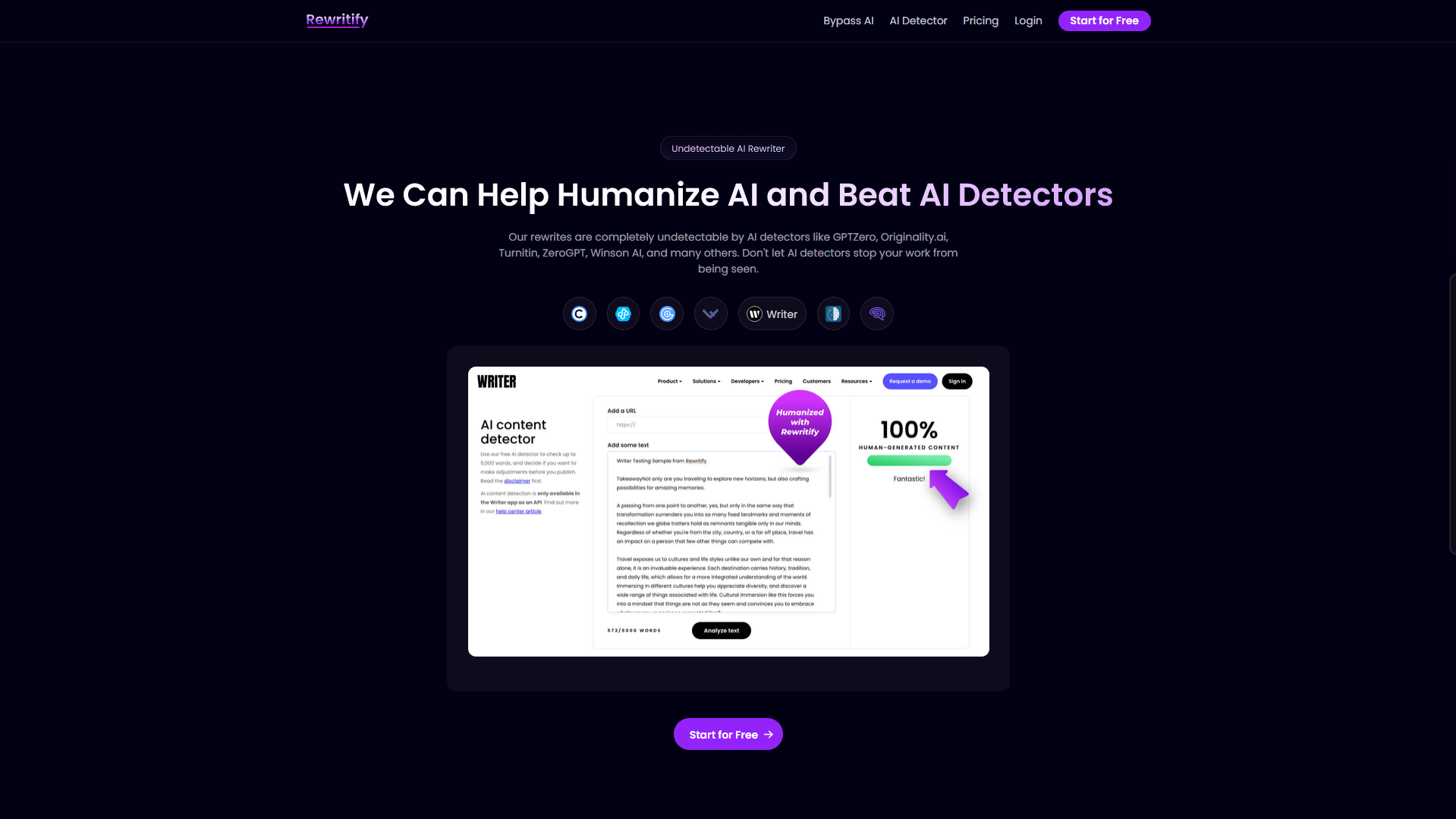
The use of text refinement solutions within the content pipeline makes it possible for marketing teams to streamline the process of drafting copy in a way that preserves brand identity. The platform such as Rewritify AI gives copywriters the ability to transform rigid AI-produced drafts into natural-sounding pieces of text. This way, the team can benefit from automation but also keep its content personalized, thus maintaining high productivity along with CRO rates.
The Future of Effective Marketing Campaigns
Artificial intelligence has no equal when it comes to scaling outreach efforts and testing copy variations. Nevertheless, there shouldn’t be any sacrifice made when it comes to human touch. Considering the growing competition among marketing channels for leads, the future belongs to those who manage to use technology to streamline production but preserve their human voice in their marketing copy.
Where the Form Itself Becomes the Problem
Most landing page audits stop at the copy. Headline tested, subheading refined, CTA button color debated in a Slack thread for three days. What rarely gets the same scrutiny is the form sitting below all of it.
This is a mistake. A lead capture form is not a passive container waiting to collect whatever the copy drives toward it. It is an active conversion point with its own friction, its own trust signals, and its own ability to kill a decision that the copy already won.
Think about what happens in the final few seconds before a B2B buyer submits their details. The copy convinced them. The offer made sense. Then they hit a form asking for their job title, company size, phone number, annual revenue, and the name of their firstborn child. The moment passes. The tab closes.
Form length is one of the most consistently underestimated conversion variables in lead generation. Every additional field beyond what is strictly necessary to qualify the lead increases abandonment. Not by a small margin. Research across B2B landing pages consistently shows that reducing form fields from six to three can lift completion rates by 50% or more. The copy did its job. The form undid it.
Designing Forms That Match the Copy's Promise
The disconnect between landing page copy and form design usually comes down to a mismatch in commitment level. Copy that promises quick, low-friction value - a free audit, a 10-minute demo, an instant report - loses credibility the moment it leads to a form that demands the kind of information you would only share with someone you already trust.
There should be an appropriate match between form and copy. In cases where the headline promises, "see your results in 60 seconds," then the form should take 60 seconds to fill. In cases where the promise is to perform a light duty first, the form should appear as such.
Purpose-built form creation tools, such as LeadGen App, give marketing teams the power to manage this matching process themselves. Instead of being stuck with a default contact form created from a CMS template, marketing teams are able to create multi-step forms which will introduce questions gradually, with simple questions appearing first and difficult questions appearing last.
The Full-Funnel View of Copy and Form Conversion
Landing page performance is not a copy problem or a form problem. It is a handoff problem. The copy earns attention and builds intent. The form either captures that intent cleanly or creates enough friction to lose it.
B2B marketers who treat these as separate workstreams; one team writing the copy, another team setting up the form in whatever tool happens to be available - are leaving conversion rate points on the table every single day. The brief that informs the copy should also inform the form structure, the number of fields, the language on the submit button, and the micro-copy that sits next to each input field.
However, when the copy and the template are created as part of the same design to achieve a specific objective by a particular user, then what emerges is a seamless lead generation process. And it is this seamlessness that makes the successful landing pages distinct from their less successful counterparts.
Conclusion
The landing page conversion problem most teams are chasing is not a traffic problem, a targeting problem, or even purely a copy problem. It is a coherence problem. When AI-generated copy lacks human nuance, buyers sense it before they consciously process it. When the form asks for more than the offer justified, the trust the copy built evaporates in seconds.
The marketers pulling ahead right now are the ones treating copy and form design as a single system with one job - moving a skeptical stranger from "this looks interesting" to "yes, here are my details." That requires copy that sounds like a person wrote it, an offer that delivers what it promises, and a form that collects only what it actually needs.
AI will keep getting faster. The copy it produces will keep getting more polished. But the brands that win lead generation in the long run are the ones who never let speed replace judgment.
FAQs
Q1: How is it possible that the traffic of my landing page increased, but the form completions decreased?
A high level of traffic and low number of form completions can indicate a lack of trust or friction rather than targeting issues. Either the landing page content appears vague and generic and the visitor gets bored before reaching the form, or the form is too demanding despite successful copy persuasion. Visitors reaching your landing page is half the battle.
Q2: In what way does AI copy influence the lead generation conversion rates?
In most cases, AI copy has typical sentence structures and buzzwords that are typical of a certain body of content you and your competitors have been trained on. B2B customers read many landing pages. They can distinguish AI copy from manually written copy and, therefore, will be hesitant about sharing personal information in a form because of this very reason.
Q3: How many fields should a B2B lead generation form contain?
It should be as many as needed for the next conversation to happen. For example, if your salesperson needs name, email, and company only to make a meaningful first phone call, then this is all the information needed in the form. Every additional question is another element of friction, which goes against the momentum built through copy.
Q4: What is the difference between behavioral intent matching and AI copywriting?
Standard AI copywriting simply fills in a template with elements such as a headline, subheadings, bullet points, CTA. The approach of behavioral intent matching starts from audience segmentation and identification of behavioral patterns, then writes copy based on that information rather than writing it for a typical buyer persona.
Q5: How do I make sure my form design matches what my landing page copy promises?
It’s the offer first and then the form creation tool. If you promised a 60-second effect, make sure the form can be filled out in 60 seconds. If your offer is a noncommittal first step, make sure the form feels that way. Make sure the person working on the form briefs himself using the same document as the copywriter. The more both people have the same idea of what was promised to the visitor, the less the transition from copy to form will seem like shifting gears.
About the Author